Showing posts with label Job. Show all posts

Wednesday, November 19, 2014

“Sitting is the new smoking”

My modified workstation with movable monitor arms and a keyboard tray that elevates. (Sorry for the mess.)
Part of the reason I jump started this blog has to do with this "disease." No, it's not really a disease just as Degenerative Disk Disease isn't one, but one creates the other. If it weren't for Sitting Disease I wouldn't have Degenerative Disk Disease in my lower back. If it weren't for Degenerative Disk Disease I wouldn't have gone to a physical therapist. If it weren't for my physical therapist I wouldn't have discovered yoga, if it wasn't for yoga, Man!, there's a lot of great things that yoga is responsible for.Only one of them is getting my doctor to sign off on getting "reasonable accommodations" at work, where I can stand and do the same work I've been doing sitting down for decades.

Here's an article from The Sacramento Bee on "Sitting Disease." I took the quote “sitting is the new smoking” as the blog title. Yes, it's over-stated, but it gets the point across. Now, get off your ass and get into a yoga class!

Tuesday, May 20, 2008

My Shaklee Daze and the Dangers of Doorbell Ditch

I don’t recall whether I received an allowance from my parents when I was a kid. I do remember working for my father at his shop on certain Saturdays and during the summer. For a short while, when there wasn’t much work at the shop, I found another means of making an income, selling Shaklee products door to door through my friend Mark’s father, Mr. Romano. Shaklee, for those who don’t know, makes cleaners, hair and skin care, and other household and personal hygiene products. Mr. Romano tried to get me, a junior, gum-popping sales representative, to be friendly and to “sell myself” to help sell the products. I didn’t understand the concept of selling oneself until I was an adult, and by that time, it was far too late.

Door-to-door sales were the early predecessor of direct marketing and Internet sales. It was effective in its time, when people interacted more. Door-to-door sales are almost nonexistent now—in an age when both husband and wife are out in the workforce and have little patience for dealing with cold callers like telemarketers. These days, most people look at anyone they spy through the door peep hole, besides friends or expected visitors, as a nuisance. I personally dread even the prospect of a youngster selling magazines, trying to save his school, or an adult from the Sierra Club, trying to save his environment; I am now on the other side of the door.

I would knock on doors and push the Shaklee catalogs at the homemakers. I wasn’t much of a salesman, but at twelve or thirteen, I really didn’t have to be. When I made a sale, it was because the women thought I was a cute kid and they didn’t want me to leave their porch empty handed, and, of course, there were the friends of my parents—that was usually a slam-dunk even if they were small sales. There were, however, the homeowners who would tell me never to bother them again.

The big challenge for me was getting over the fear of knocking on a stranger’s door. Long before I sold Shaklee, I was like any other kid: trusting, curious, perfect bait for a pervert. (Stone Phillips could have used me to catch child molesters and pump up his show’s ratings and his image as a Champion of the People and Enemy of the Sexual Predators in Your Neighborhood.) All of that changed when I started playing with my friend Dave McKensie. Dave was a nice kid, but his dad was a different story. Quiet, private, and much older than the rest of my friends’ dads, Mr. McKensie had a horrible temper if you caught him at the wrong time.

When I knocked on the door one summer evening to see if Dave could come out and play, Mr. McKensie swung open the door, pointed his bony finger at me, and yelled that I should never bother his family while they were eating supper. Besides scaring the crap out of me, his demand begged the question: how would I know when the McKensies were having dinner? Did I miss the big neon sign stating, “Dinner time for the McKensies—do not disturb!”? My family had dinner around 7:00 p.m.; shortly after my father got home, but there were countless times when we ate earlier and without him.

Moreover, what’s the big deal about knocking on the door during dinner, I wondered. Our next-door neighbor, my brother’s best friend, came over all the time when we were eating, big deal! I only knocked on the McKensie’s door around their dinner time one other time in the eight or so years I knew Dave and that was when I forgot it was somewhere in the general time of dinner. Mr. McKensie, clad in a wife beater, said in a low, agitated tone, “Yes?” I knew I blew it and immediately apologized, backing away from the door to give him room for his bony finger. He quickly came back as if he didn’t hear my apology, “Well, what is it?” “Ah, nothing, Mr. McKensie,” I said nervously. “Is that it, is that your message to David—‘nothing’?” his voice building up anger and sarcasm. Just then Dave walked up to the door as his father shouted my message directly into his face, “David, NOTHING!” When Dave cleared the door Mr. McKensie slammed it shut, as if it was Dave’s fault, poor Dave.

I never had a front porch experience like the two at the McKensie house when I was selling Shaklee, and while my sales area included Dave’s house, I gave the angry guy’s house a wide berth. Still, staring at a door just before knocking always made me feel uneasy—would I be interrupting another crazy Irishman’s meal?

While these two experiences with Mr. McKensie finally trained me never to knock on his front door during the early evening. I had one other experience with Mr. McKensie at his door, unrelated to selling Shaklee or interrupting dinner, but I feel I must relate how scary this guy was to children, how he seemed to have no warmth toward any other child, except, maybe, his own.

Dave told me at school one day that his parents were going out and he would have the house all to himself—an obvious invitation to come over and have some unsupervised fun. That evening, when it got dark, I walked over to Dave’s house, hit the doorbell about six or seven times, and then ran around the side of the house. As I ran to take cover, Mr. McKensie’s hunting dog began barking wildly. I heard the door open, but instead of Dave making some wisecrack about me playing an adolescent game like doorbell ditch (we were both in high school by now), it was all quiet. I slowly poked my head around the McKensie’s garage, and to my horror, I saw the unmistakable shadow of Mr. McKensie.

He waited there for about five long seconds, while the dog continued to bark madly, and then said in a loud voice, “Well, where are you, you goddamn son of a bitch?” I stood there petrified. One of the main tenets of doorbell ditch (or ding-dong ditch) is that you have an exit plan before you execute, but I was expecting Dave—I didn’t need an exit plan. I was stuck and when I saw Mr. McKensie’s shadow turn in my direction I knew I had nowhere to go. I ran out in plain view and apologized, telling him Dave said he was going to be home alone, and I... blubber, blubber, blubber... Mr. McKensie shouted me down, something about how he wished I hadn’t come out from hiding. Something like that, I think. I later thought about it. Did he want to attack me? I’ll never know, I guess.

I don’t know whether Mrs. McKensie would have bought Shaklee products, but I never tried to sell her anything. There were some big scores, some from friends of the family and my schoolmate’s parents, and on one occasion, I sold a bunch of junk to a lonely old lady who just wanted some company. I sat down on her couch, took in the strange smell I always associated with old people I didn’t know, and started jabbering about different products in the catalogs that I had no real confidence in. This lady found a product called “Proteinized Velva Dew.” She kept repeating the name, as if she enjoyed saying it. I wanted to tell her to shut up, because I hated the name. She ended up buying a ridiculously large amount of the ill-named moisturizer. Later that day, I returned to Mr. Romano’s house with my order forms. “Hey, look at all the Proteinized Velva Dew you sold! That Proteinized Velva Dew must be some good stuff,” he said, ignoring the obvious fact that this was a new customer and probably had no idea how good or bad the stuff was. As he filled out his master order form, he tortured me by repeating “PRO-teeeenized VEL-va-Dew.”

A few days later Mr. Romano invited me and Dave (that’s right, Dave McKensie was a Shaklee junior sales representative, too) to a sales meeting. On the night of the meeting, Mr. Romano asked me to answer the door while he set up a Super-8 projector and screen, and set out some new products for us to look over.

Our team turned out to be a very strange group of salespeople. There were two morbidly obese ladies who could barely walk. How did they get around, I wondered; they were thoroughly winded from just walking from the front door to the couch, where they both stayed, never getting up to look at the new product line. There was Mark and his older brother Steve, who looked embarrassed about his father’s part-time job—like John Belushi’s character in the SNL skit about the Scotch Tape Store. Steve kept trying to find excuses to leave the room, but Mr. Romano would yell at him to stay put. I figured there was some history between them and Shaklee selling. Finally, there was Dave, and, of course, me. Mr. Romano held up the film while we waited for the last expected salesperson. When I answered his knock, I found a thin, bearded, distinguished-looking man in a brown business suit at the door. Here was the only one in the group who actually looked like a salesman, I thought for a moment. I opened the door wider to let him in and noticed that he walked with a disability—dragging one foot behind the other. As he schlepped past me he slurred a loud, wet “Thhhaaouuu” too close to my face. Throughout the meeting, he kept yelling over the film’s narrator about how his mother bought this product and bought that product until it became clear that his mother was his only client.

Dave and I had assumed positions on the floor while the others sat on the couch and the chairs Mr. Romano had assembled in a semicircle around the screen. The film bored me to tears. It was about what was new and improved at Shaklee. As the narrator droned on I became sleepy, and I began to make myself more comfortable—shifting from Indian-style to a position so my upper torso was leaning on one arm. Then I folded that arm and supported myself by my elbow and forearm, finally I couldn’t stand it anymore and decided to just lie on the carpeted floor on one side, my head supported by my extended arm—watching the film at a ninety-degree angle. During my descent to the Romano’s beige pile, Dave had been trying to suppress his laughter through coughs; it may have sounded to others as though he was having an allergic reaction to something. Mr. Romano asked Dave if he wanted a drink of water. I could tell Dave was laughing at me; I didn’t see the humor in my actions at the time, but I guess it must have looked as though I was making myself at home during what was supposed to be a business meeting with my fellow sales associates—the movers and shakers of Shaklee.

Since I was lying in front of everyone else, I could close my eyes undetected, but just when I thought I might nod off, the film’s narrator started talking about Proteinized Velva Dew. My eyes popped open as my ears took in the annoying name. Then I got the feeling someone was staring at me. Something told me not to look, but I was a glutton for punishment. I looked around and there was Mr. Romano, his face flickering in the projector’s light, all teeth. “Hey everybody, Jocko just sold a whole case of Proteinized Velva Dew! Good ole Proteinized Velva Dew!” He had to repeat the product’s stupid name. The crowd of misfits all groaned their support in unison. The man in the brown suit said he sold some to his mom.

I never attended another business meeting again and inside of about a month or two stopped selling door to door. I found I’d rather clean up wood chips at my dad’s shop occasionally. I would sometimes think about going back to Mr. Romano and taking up Shaklee again, but one summer day, when Mark was in a particularly destructive mood, he disassembled a fence next to my house. Perhaps it was the way the slats on this particular fence weren’t nailed into place—once one came out, the rest were loosened, and Mark just kept taking them out and stacking them. I was guilty of not stopping him, telling on him, or at least running away. I sat there and laughed my ass off at Mark’s funny remarks as he removed all the middle boards from the fence.

I don’t remember whether someone saw me around the fence with the conspicuous empty middle section or heard my unmistakable laugh, or whether I just couldn’t lie to my mom when she asked if I knew who did it. I do remember having to re-assemble the fence without Mark. I could have narced on him, but I did not—taking hits for other people so they wouldn’t hate me was one of my weird traits. Of course, what ultimately happened is that I no longer wanted to be around him anymore, so why didn’t I narc on him anyway? I guess my brain is just wired that way. What was worse is that the fence belonged to a man whose daughter I was sweet on and she never spoke to me after that. The whole experience soured me on selling any more Proteinized Velva Dew for Mark’s dad.

What is glaringly missing here, my college English professors would say, is a conclusion that sums up the whole story of knocking on doors, having a mean Irishman yelling at me from his front door, selling stuff I couldn’t care less about, and, oh yeah, disassembling a fence. (And how did that last subject get in here, anyway?) I guess I did all this writing without a poignant or pithy ending in mind. I never could sell myself.

Saturday, November 24, 2007


Career Opportunities

I am currently working on getting a promotion, a promotion that I frankly don’t think I deserve, and I don’t think I will receive. Okay, the fact is, I don’t think I really want to receive the promotion. There, I said it. I don’t know how many people in civil service ever have these kinds of feelings. I do think that civil service can sometimes be like building a pyramid, going as far you can possibly go until you feel you have maxed out or you die. Perhaps it’s something like the Freemason’s pyramid on the back of the one dollar bill. (The iconography may be on other bills, but I wouldn’t know right now; my wife—who makes twice as much as me—regularly “Jane Jetsons” me. She sings the TV theme song as she goes through my wallet for the larger bills.) The incomplete pyramid represents, if I remember my early U.S. history correctly, the idea that God’s work is never done under the all-seeing “eye of Providence.” In my secular interpretation of this Masonic symbol, aggressive civil servants keep gunning for promotions—not necessarily looking at where or when they will stop; if they have the self-confidence to keep going, why not? Forget about whether they deserve it or whether the whole system is self-serving, they just keep locking down those golden handcuffs!

This is exactly like me, except in super-slow motion and without the self-confidence. There was a time, though, that I figured I would never even get to where I am. My career path out of high school started with panic. Before I graduated from high school, I visited my counselor. It was time for Mrs. Connelly to tell me what my options were for college: UOP, UCD, or maybe USC. It turned out the only USC I qualified for was the University of Southern Carmichael–the local community college American River College. With news of fellow classmates being accepted to Stanford, Cal, and UCLA, I somehow assumed that even with my sterling 2.3 GPA, some prestigious college would love to have me. When Mrs. Connelly said defensively, “Hey look, you were the one who couldn’t get a passing grade in ceramics, what do you expect from me?” I panicked.

As I remember it, on the first weekday as a high school graduate, I found myself downtown in the U.S. Post Office and Courthouse building. I started with my first choice: the Coast Guard. You see, when the college thing fell through, my plan was to go to the Coast Guard Academy and become an oceanographer or maybe an ocean photographer. (At one point I thought the two were the same.) After graduating from the academy, I would put in my time taking pictures of fish; then, if I decided to leave after my service was up, I would become a firefighter.

Firefighting seemed cool—not the actual firefighting part, but the fact that someone actually pays you for laying around a station watching TV and playing cards, at least that is how firefighting was depicted on TV—my chief educator. Since it’s a great-paying part-time job, I figured I could either kick it during the abundant time off, or get another low-pressure job and put in the time I wanted before I had to go back to the station and resume laying around and watching TV—what a breeze.

Sitting across from a butch-haired young man wearing an immaculate white uniform, my plan unraveled fast. First the academy, then oceanography, Butch couldn’t even promise a stint taking ID photos of sailors, but that didn’t stop me from signing up to be a yeoman just like Butch. I have never been able to explain to my family’s satisfaction why I continued to allow the yeoman to fill out the enlistment papers after finding out I wasn’t going to go to the academy, etc. Nor can I explain without being embarrassed that I thought oceanography would be fun—I didn’t really consider oceanography a science, my worst subject in high school, besides ceramics. I had a big book on ocean fish and another on sharks, but since I only looked at the color pictures I somehow associated oceanography with photography. Regardless, when the time came, I signed on the dotted line. The only reason I wasn’t stuck scrubbing decks or sitting in an boring office signing up suckers like me was found on a separate form yeoman Butch forgot to fill out but remembered just as I was getting up: my medical information form. It was the medication I took for my seizure disorder—the same disorder that made me feel like an undermench, brittle among flexible young men—that spared me the sponge and bleach.

At that time, I didn’t see the one and only good byproduct of suffering through humiliating seizures in front of friends and strangers and being the "special" kid who had to take pills with his lunch. No, all I did was panic some more. “What am I going to do now?” I cried to myself. What I did was hit every other enlistment office in the Post Office. After being rejected by the National Guard, the Navy, the Air Force, and the Army, I found myself in front of the last office: U.S.M.C. it read on the shingle outside the door. I remember almost running into the office and abruptly asking without any introduction to a black man sitting at a desk reading the paper if the Marines would accept someone who takes medication for seizures. The pleasant looking older man with salt and pepper hair looked up from his paper and with a warm smile said, “Son, I bet you have been to every other enlistment office in the building, haven’t you?”

As I sat on the steps outside the building, emotionally shot, I saw a homeless man pushing a shopping cart full of crushed cans and thought, “That is me in one year.”

Of course, I didn’t end up a transient; my parents didn’t throw me out into the street, they were very patient with me. I started attending college, and I quit my job at Taco Bell to sell shoes until I got the brilliant idea I didn’t need college—I could sell shoes on a full-time basis and skip the school gig; college was for losers.

Besides dropping out of college being hubris, the decision to take on a full-time job that depended on commission ignored one glaring fact: I didn’t have the people skills required to sell shoes. Week after week, I would receive paychecks from Florsheim Shoes—each one said I made $50 in wages and, on an average, $40 in commissions. This brought me to about $90, which was $70 below minimum wage; California law forced Florsheim to pony up the balance each week. “Earnings Adjusted” was the caption of shame that contained the money that I didn’t earn but had to be given to me to make it legal. I actually made more money at Taco Bell as the nightshift crew chief, where I made two bits an hour over minimum wage. During weekly staff meetings, my manager, Jay (who also happened to be my best friend and the inspiration for my dropping out of college so I could make big bucks selling shoes) would ask me, “So, you’re getting the hang of this, right?” If I weren’t his friend, he would have righteously fired me. In retrospect, that would have been the best thing for me; instead, I lasted almost a year making minimum wage on Florsheim’s dime. I followed Jay to Julius Clothing, where I worked as a stock clerk for a short stint, learning just how much the markup is on high fashion clothing. Then, for some insane reason, I returned to Florsheim and languished there until landing what I still consider the best job I ever had.

For a couple of years, I attended college again and wrote movie and music reviews for the American River College campus paper—The Beaver (now The Current). While attending screenings at the Tower Theatre as a movie critic, I started up a friendship with the manager. When a position opened up there, I applied and got a job tearing tickets. I spent the rest of my college years studying journalism with the hopes of becoming a rock critic like my heroes Greil Marcus and Robert Christgau. Of course, working at the Tower turned me into a bit of a film aficionado (snob) as well. More importantly, I developed friendships like those I never had before or since.

The last days of college turned out to be just like the ones in high school: fraught with panic. As I was finishing up my degree in journalism I figured I couldn’t cut it as a journalist. I was told by editors from both the Sacramento Bee and Union at a career fair that "all writers" have to work their way up from cub reporter doing ads, funeral notices, and other short news pieces before they can work in the field they want. I felt I couldn’t (or wouldn't) go through this process. This gloomy outlook on my chances to become a music/film critic, it turned out, was not true; things were changing in the newspaper business, and the old salts I had talked with were only reflecting how they remembered their own career paths.

So what was I going to do being so close to graduating with a BA in Journalism and not wanting to be a journalist? Before running down to the Post Office building a friend told me about a proofreading job for the State of California. With my journalism skills and credentials (I edited two college papers) I aced the exam, the job test, and job interview, and got a position as a proofreader. Thus began my long career in civil service.

While I have always had self-confidence problems I believe civil service has worn what little I had down to a nub. This lack in self-confidence has manifested itself in the last ten or so years in shiftlessness. In an age when most professionals are expected to move up or out every three years, I have moved only three in over 20, and in seventeen of that score I have worked in a depressing basement of the same building. Since I have been working in civil service I have seen many coworkers who have had the same classification as me, or lower, move many steps above my current classification. While this is humiliating I am not bitter at their successes; I am quite intimidated at the work they do: they have earned their station and I have earned mine.

I rarely attempt to move up anymore, rarely apply for new jobs, and rarely work on my resume. But that doesn’t stop me from wishing I were doing something else. The last promotion I received was handed to me—all I did was whine at the right person. I was sitting at my desk when I saw my old boss walk through the door. My current manager was leaving, and the job announcement was out for her replacement. When Fred came through the warehouse doors, asking about the open position, I jumped out of my seat and ran to him like Peter to the resurrected Jesus. This was the same person I had problems with in the past and about whom I used to spend hours telling my crew how much of a jerk he was and how glad I was not to be under his boot heel. I asked what he was doing down here, though I already knew. When he confirmed my hunch, I went into action. I gave him a tour of the warehouse and then complained to him that I didn’t want to work in my current position anymore. He reacted the way I knew he would, saying, “If I get the job, I’m going to make some changes around here.” To any rational man with an ounce of self respect, this should have been my exit queue, but that didn’t bother me, nor was I phased by the fact that his promise to “change things around here” was a direct criticism of how I ran my shop. I just sat back and waited for my new assignment and, ultimately, my bigger paycheck.

Ironically, when the new classification came, it dawned on me that any hope of leaving civil service for an outside, private job with equal pay and benefits was as good as gone: I was now making more money than I could ever hope for on the outside considering my skill level—the ratchet on those golden handcuffs clicked down. Time went on, and I didn’t move up the ladder or on to a different post or agency. On the rare occasion that I attempt to move, the ultimate denial only reaffirms the self-fulfilling prophecy that I didn’t deserve it.

So, I have worked the same old job for over five years rarely pursuing any change in venue or attempting to make more money for being just as miserable. At times, I wish I were more ambitious; at other times, I wish I could be content in my station—that would be the Christian way to look at it. About a year ago, in a Bible study, when we were taking prayer requests, Ken, a Brother who works for a state agency, chimed in asking for a prayer of thanks, saying, “I got a promotion!” We all clapped and congratulated him. After the study, when we were outside the hall, I asked him what his new classification was. With a great big grin, he said, “You are now lookin’ at an Office Technician, Brother, or at least I will be when the paperwork goes through.” Ken is a 50-year-old file clerk who is happy doing entry-level work. He was so happy that I was surprised he wasn’t a Staff or an Associate Analyst—how could someone be happy being a clerk at his age. I knew the answer. I just couldn’t be happy being what I am, which is a sin.

Recently, in a closed-door meeting, a co-worker, Sharon, told my current manager, Andrew, that it was time for our agency to promote me. If Fred were still my manager, he would have promoted me a second time by now, not because I deserve it, but because he promoted his staff to justify his own promotions—this is how civil servant managers build that seemingly endless pyramid. I didn’t know anything about the meeting Sharon and Andrew had until it was over and she told me what she had said.

In the following two weeks, Sharon provided me with other people’s promotion paperwork as templates for my own paperwork. This wasn’t the first time someone else spoke up for me; a couple of months prior, one of my dearest friends, Sophie, left the agency. At her going-away party, she took Andrew aside and said, “Jocko doesn’t promote himself, but he is an excellent employee, and a very dear friend. Watch out for him.” On the bus going home that night I wept, partly because Sophie cares that much (though she has nothing to lose by saying this stuff) and partly because I need people like Sophie (and Sharon) to fight my battles for me.

So this is how I kicked off my promotion process—with a little help from my friends—friends who really, truly didn’t know whether I deserved a raise. Both Sharon and Sophie have been promoted twice since my last raise, and they were probably sensitive enough to think I was embarrassed about that, which I am, but also it is the civil servant thing to do—to get promoted—and I am obviously not doing a good job at it. A month after Sharon’s meeting, I submitted my papers. I have no idea how this will go; my boss hasn’t said a word, and there is only about a month left before the promotion committee reviews all the candidates. I think I am going to dread the outcome regardless—these golden handcuffs are tight enough.

Monday, April 16, 2007

The Posole Dash
I used to run a small warehouse in downtown Sacramento. Actually, it was less of a warehouse than a 5,000 square foot, hollowed-out office space with pallet racking and a forklift modified not to go through the eight-and-a-half-foot ceiling.

We were a bunch of guys who cussed and joked too much and encouraged each other’s poor eating and communication habits. Occasionally I would hire a female, but they would never last long; the testosterone-laden environment was more conducive to farts, belches, and jokes about these two gastric expulsions than things more feminine. Another thing that sped up the elimination of temporary female personnel was the warehouse’s refrigerator. Even now, when women make up nearly half of the staff and the atmosphere is more professional, we don’t always get around to cleaning the fridge properly, and the females are the most vocal about this problem. Still, compared to the old fridge, the one we have now is as sanitary as a surgical instrument table.

It was not that we never cleaned the fridge back in the old warehouse days, but we would invariably wait until things got vile before one of us got around to cleaning it. When that happened, there was usually only an old green sandwich or a half-bottle of orange juice that was no longer orange. However, there was one time none of us will ever forget. The people who lived through it would rather forget it, but I tell this cautionary tale to the rookies who skip their turn cleaning the break area.

In our fridge, we had a huge bowl of posole. Occasionally, women would feed us guys something they made from home. This was usually due to some maternal thing, but in this case, Rita, a woman who worked across the hall, had potluck leftovers and didn’t want to lug the stew home. When she first brought it in and asked if we wanted it, I saw a thick stew that would have smelled appealing any other day, but I wasn’t interested having just eaten. All the other guys had already eaten, too. I knew I was going to try it the next day and one of my staff also vowed to have some soon.

For reasons I have long forgotten, I never did try the posole and I think that also goes for the rest of the staff. So the posole sat in the fridge. Days turned to weeks, weeks to months, and the posole remained in the fridge. Since I was (and still am) foolish enough to eat out for lunch or, when I am a little more fiscally responsible, bring in a sandwich and chips, I never looked in the fridge, nor did I ever hear a peep out of my staff about the posole. For all I knew, the stew had been removed from the fridge months ago.

I didn’t know Rita was in the shop until I heard her cry “Oh my God!” followed by what sounded like a dry heave. As she left, she pointed with a quivering finger and said, “I need my bowl, but I’m not washing that out of it!” It took me a few seconds to process this statement. The required set of synapses had to fire for me to conclude that the bowl of the posole was still in the fridge. I chuckled almost in disbelief; I mean really, who would leave a bowl of stew uncovered in that dirty icebox for that long?

When I approached the fridge I could smell it; the remaining stench from when Rita had opened the door hung in the air like a death haze. I have never smelled anything like it. This was worse than the day my friend JT and I visited the old County Morgue. JT was helping me look for possible jobs and there was an opening as an office clerk there. After receiving the details of what this clerk’s responsibilities were–heavily peppered with macabre humor–we were on our way out of the building when JT cut in front of me and stepped on a pressurized doormat that opened a door to the corpse hold. The cold air hit me in the face, then the smell, and then, after my eyes focused, I was staring into a room of cloaked dead bodies on gurneys–one whose arm had fallen off the gurney, purple, grey, and black. JT impishly smiled at me. The whole experience was permanently burned into my memory cells. Thanks, JT!

I don’t remember getting the chance to look at the bowl or even shutting the door, but someone must have. I spoke with the crew about the situation as if I was choreographing a multi-pallet shipment. The task force consisted of three people: Brad, Ricardo, and me. I lead a five-man staff, but one of them was hired post-posole and the other guy, a problem employee from the beginning, made it perfectly clear that he didn’t like posole in the first place and told the woman so when she dropped off the bowl three or four or five months ago. We split up the tasks.

We had to move the bowl of posole approximately eighty feet to the nearest toilet where one of us would do the honors. Ricardo valiantly volunteered to take the bowl all the way to the bathroom, but felt his vomit launch begin to countdown when he reached in the fridge to pick up the bowl. He was out. It came down to Brad and me. I was proud of Brad for being a team player, even though the Irish wimp cannot handle anything remotely spicy and didn’t want the posole in the first place. (Brad couldn’t even muster a second bite out of a mis-delivered McDonald’s Spicy Chicken Sandwich. McDonalds, I tell you!) Brad took the first seventy or so feet, setting the bowl on the lobby’s candy machine! Sweat collected on his freckled brow; he was done.

Now it was my turn. Like a fool, I picked up the bowl before checking to see if someone was occupying the first stall. I had to double back – not only was the first stall occupied, none other than Tim Rothschild occupied it. Rothschild prefers to do his business in the basement so fewer of his co-workers have to partake in the byproduct of all those Snickers and Pringles he stashes in his cubicle.

I couldn’t wait in the lobby with the posole and there is no way in hell I was going to take it back – I left the stinking bowl on the candy machine. No one would be buying any Snickers this afternoon. I went back into my office and drank some water, and released some frustration towards sissy Ricardo: “My God, man, you’re a Mexican, proud of your tolerance for habanera peppers, and you can’t handle a little necrotic pork?” Speaking of necrotic, I checked the bathroom again about five minutes later, and Rothschild was still there.

I waited a good ten more minutes before bothering to check again. By this time, the entire lobby reeked. I peeked in the Men’s room to see that no one was in the stall, but Rothschild’s essence was as strong as if freshly squeezed. I couldn’t wait any longer. I grabbed the bowl, ran into the bathroom, into the first stall, only to notice as I bent down to dump the posole that someone was in the back, handicapped stall.

As I bent over and began pouring the rotten stew–dry heaving all along–a bone, hidden in the mucus, slid out and hit the porcelain with a resounding “DINK.” I couldn’t laugh, but still had to wonder what the person in the other stall was thinking. Let’s see: a guy runs in to a stall, stands before the toilet and evacuates a gallon of the foulest smelling fluid from his stomach, and then accidentally drops something into the swill. Whatever it was, it was worth diving into his own rejected lunch to fetch it. Is a Rolex worth that much?

I threw the shiny, slippery bone into the paper towel receptacle, washed, and dried the bowl, all the while still heaving and brought the bowl back to the warehouse. I never knew who was in that other stall, and I don’t know who gave the bowl back to Rita. That night we defrosted the old icebox – keeping the door open to the max, hoping the smell would dissipate by morning.

Now, whenever my name comes up on KP duty, I preface my fridge cleaning with an email to all staff members reminding them how merciless I am about throwing out anything that is not clearly marked and that doesn’t look right. Some poor bastard once lost a half-full jug of Odwalla juice – how was I to know it was still good, it was green! I tell my fellow staff members it’s all for the greater good, nobody wants to do the Posole Dash!

Tuesday, August 01, 2006

The Week I Thought My New Boss was a Ninja
For five months, my office thrived without a manager. In that time we enjoyed long lunches, took breaks whenever we felt like it, and with the exception of only a couple of minor issues that brought down the section manager, it was a very relaxed and productive period.


Our office was like an open city: in-between the departure of one governing body and the occupation of a future one. Since we were only loosely supervised, we never felt we needed to be on guard and in fear of the boss. Unlike before, we were not bombarded by calls from the boss to see him in his office; nor were we pinned down in our cubes, pressed until we answered questions to his satisfaction. In addition, his absence from staff meetings was so refreshing that I made it a point to show up to these gatherings on my own time and nobody cared.

Just like the best all-night pool parties, our hiatus from office management had to end. An occupying force was bound to invade our little open city and re-establish “order.” While it is too early to tell how we will regard our new boss, one thing is for sure, if you would have asked me what I thought of him in that first week I would have told you that he was a ninja!

He was so busy the first day signing papers from our accounting and personnel offices, and getting his PC and phone set up that he was virtually invisible, but that is not the ninja part. It was on his second day when, with ninja-like stealth, he walked through our cubicle farm, surprising everyone. I was busted playing a sudoku puzzle, Edna was caught taking an unscheduled break watching her soap opera on Web-TV and eating cold cereal, I heard her attempting to say "Good morning" through a mouth full of milk and Special K. At the very same time our new boss was jolting Edna out of the world of melodrama and feminine hygiene product commercials, Dorothy was caught sleeping.


On the third day, when he began his walk through the cubes, I heard him speaking to Maureen, the woman who sits in front of me. A moment later, he was talking to Dorothy, the woman who sits behind me. There was no sound of his movement past me – and, believe me, with a half-done sudoku in in front of me, I was listening for him. It also took him only a second to pass me and engage Dorothy in his very soft voice. Did he fly by? My first – foolish – thought was that he threw his voice, but when I heard Dorothy reply to his query, I had to get up and confirm that he was standing in Dorothy’s cube.

When he left that day, I crossed him in the stairwell. He was skipping every other step as he bounded up the staircase. This is in itself nothing special; many people do it, but without making a sound? I only noticed him because he suddenly appeared below me. We reached the landing between the basement and first floor at about the same time. He spoke to me softly, “I’ll see you tomorrow—”. We passed one another. I took two steps on the landing and looked back up, thinking he was going to finish his sentence, give me a command, say goodnight, or something, but he had vanished – all I heard was the door to the first floor shutting.

On the fourth day, we had a party for a couple of departing employees. Occasionally, someone would ask me who my new boss is. When I tried to point him out in the crowd, he would disappear only to appear a second later across the room. A couple of people gave up on me identifying him, probably thinking I had spiked my cup of punch or something. Then he would appear behind me. The whole thing got nerve racking. On the fifth day things calmed down a bit, but still my boss seemed to appear and disappear from his office without anyone's knowledge of his movements. Creepy.


It is week number two of my new manager’s assignment and the mystery has vanished; we see him walking about the warehouse, he says hello to everyone in the office giving up his location in time for us to stash the sudokus and shut down the soap operas; he is just another guy and this is all for the best, I have got some sudokus to solve!

Tuesday, April 11, 2006

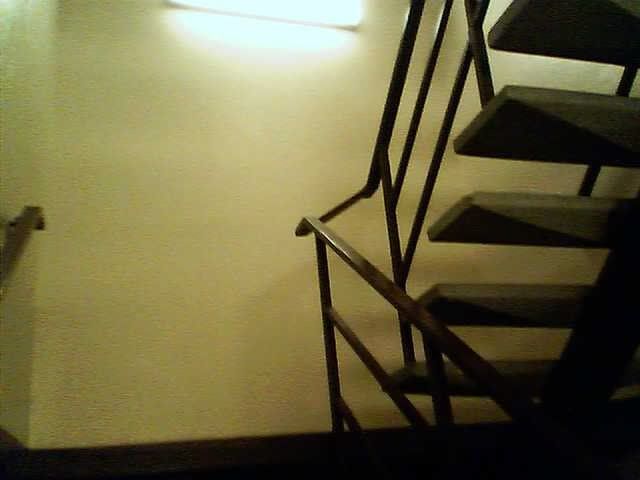
The Office Workout: Stairwell Therapy
There’s a guy I know who works in my building who has cut caffeine out of his diet, resorting to green tea as an alternative to coffee which he used to drink quite frequently. While I find green tea as appealing of an alternative to coffee as chicken noodle soup to steak (only preferring these if I am really ill), I suppose since he is in excellent physical shape there’s not much else he can do to improve on his Greek-god like body. When my doctor regards my pathetic tabernacle and finds out that I drink coffee with my stable of Blizzards, Dilly Bars, and Buster Bars, he tells me to lay off the ice cream then leaves the examining room with a whoosh of his lab coat; nothing about cutting down on cafe. So you see caffeine is the least of my worries. Anyway, I don’t really drink that much – less than three cups a day. It is the mass consumption of Dairy Queen Products, not to mention, bread, rice, potatoes, and second helpings of all the above and more that I need to declare a moratorium on.

But there’s change in the air, my dear two readers! A couple of weeks ago my old friend Monique came down to the dungeon where I work and asked if I would like to walk to the seventh floor with her. “Why, are the elevators out?” She looked at me the way my wife does when I’ve reloaded too many times at the Indian casino buffet. “Oh, you want me to exercise with you; got it!” I said figuring out her glare. I didn’t really get a chance to think over the offer when she ducked in the stairwell and motioned me in – like she was going to dish some delicious dirt.

Leading the way, I started yakking about how our old manager “used to take these stairs everywhere – never using the elevator unless he was accompanying the director and that it was probably bad news for who ever they were going to visit and definitely bad news for our old manag,” “Be quiet!,” she said cutting me off. “Preserve your energy,” she gasped half-way between the basement and the first floor. It was too late my weight, my atrophied legs, and my jacking jaw did me in already. By the time we made it to Floor Seven I could feel my pulse through my eyeballs and my legs were quaking like an extended arm balancing a cane in the palm of the hand. When we walked all the way down the stairs Monique said we should do this once a day. I don’t know what evil spirit was in me at the time, but before I could scream “Are you out of your flippin’ mind?” a voice from somewhere in my throbbing melon said “Sure Monique, let’s do it.”

The next morning I was so sore I could barely stand up. I felt I needed a day or two to, as I told my wife “let the muscles relax and grow.” My wife, the nurse, did not side with me, “No, you need to continue.” We argued, but it was no use. My wife has the license and the big medical terms – all I have is the pleading lingo that has never worked with her.

After two weeks of this routine my legs stopped being sore, but I was still winded every time we did the walk. Besides these walks I also started taking the stairs whenever when I move about the building from floor to floor. This also included scheduled trips like going to an 8:30 meeting on the Sixth Floor every morning. When I walk into these meetings I can’t help but wonder if anyone can tell I am attempting to catch my breath and, at the same time, attempting to cover it up. I don’t know how dangerous this is – trying to breath regularly when you want to gasp. When scaling the six floor to the morning meeting a seemingly insignificant item as a planner becomes a boat anchor after Floor Four and by the time I reach my destination, before I open the stairwell door stagger out into the lobby, I am thankful that I never write in the damn thing – ink is just more weight.

I also, have scheduled trips every Monday, Wednesday mornings and Friday afternoons. On these trips I carry out-of-date two-pound data collectors and extra batteries to stations on the fifth and second floors. Not one trip to the fifth floor passes where I don’t have the urge to test the drop specifications of these “bricks-on-sticks.”

As an exercising tool you can’t make the stairwell stepping experience sexy. “It’s like the StairMaster, but more dangerous!” See what I mean. I suppose you could dress down, put a towel around your neck and work out in the stairwell during lunch, but who would want to smell B.O. in a confined place like a staircase?

Every once in a while we’ll run into someone who appears to be doing the same thing we are – they aren’t carrying anything and have that deep breathing in concert with a look of purpose on their faces as if this ugly, puke-yellow staircase is where they want to be, instead of the best cardio workout-while-you-work routine. Then there are the annoying guys who are just moving from one floor down to the next because it’s faster than the elevators. These are the guys who like to gallop down the stairs, staying airborne for too long at times, as if the laws of physics don’t apply to them. I swing wide on the landings to let them pass, but the gallop turns into a steady pace as I proceed down the next traverse only for them to start up with that gallop again. I feel a little like Ichabod Crane, afraid to turn around and face my pursuer who is in such a hurry, but refuses to overtake me.

The stairwell is a place where you find out just what kind of people these fellow stairwell travelers are. I suppose you could say the same thing about elevator sojourners. One of my more sophomoric, not to mention dangerous, elevator tricks when I worked as an evening proof reader in a near-vacant thirteen-floor building was to attempt to pry open the elevator doors when the car was in full motion. Boom! The elevator would perform an emergency stop, making the passengers feel their weight displace with a light, but significant thud. I stopped performing this little squealer when the car stopped between floors and stuck there. I was trying to impress the two female proofers I was with at the time. We were stuck there for three hours where I learned a lot about those elevator travelers.

Another trick I learned – this one from my high school sociology teacher – is that people will always balance out the spaces between fellow elevator travelers as more people leave a full elevator on a long trip. I would not move – occasionally pining someone to a corner of the cab as it continued its move up (or down) the empty out. My victim would finally get out in a huff before their appointed stop or would ask if I would move over.

I don’t know of any tricks for the stairwell and I don’t think I want to learn any. It has become a necessary evil until I get in shape; that and trying to lay off the Dilly Bars, but there’s no way I’m going to exchange coffee for green tea!

Wednesday, March 08, 2006

Cracking a Smile
I was walking to work the other day when I ran into one of the women who work in my building. “Smile, it can’t be all that bad.” I give her a perfunctory grin to make her happy. I thought “Man, do I look that serious? I’m not in a bad mood – I haven’t looked at my desk yet.” I run into another fellow employee about fifty feet up the mall who tells me one of her funny one-liners as we pass each other. This time I crack a genuine smile. Then, for the first time ever, for reasons I still don’t know, I attempt to hold that expression. I hold it for a quarter of a mile, passing other fellow workers who smile back at me. I smile all the way into my office building. At the elevator a woman who rarely addresses me smiles and says hello. She addresses me by name and asks how I am doing.

“Hmm, maybe this smiling thing is something I should work on,” I say to myself. But by this time my facial muscles begin to ache, you know, like your legs do on the day after the first ski trip of the season. I have always been told I look too serious. In family pictures there are two faces of me: the candid ones where I look like I belong in a Bergman film and the staged ones where my mom, her arms akimbo, says “Smile, this is [Insert name of any festive occasion].”

Most of the people who know me think I’m a nice guy; maybe a little too self-absorbed at times, but not enough to warrant them thinking that I’m nursing a hemorrhoid or plotting their bloody demise. Then again, I can remember these guys telling people I am a “nice guy” – as if my friends don’t think I did a good enough job conveying that message directly.

I once interviewed for a job I just knew I was going to get. Looking back on the experience now and considering the other applicants, I am not so sure I had this one cinched up. Still, the guy who got the job – someone who worked under me – said he thought he got position because he’s an “easy-going guy.” I should have read into that, but I was too pissed about not getting the position and humiliated that someone under me was chosen. I didn’t smile for weeks. If someone would have told me back then “Smile, it can’t be all that bad” I would have broken a window!

I’ve heard from outside sources (the inside source being my mother) that smiling is good for you – both muscularly and emotionally. There have been scholarly studies done on this. Can you imagine getting a Masters in Smiling? There is even such a thing as “Laughter Yoga.” (Don’t laugh, here’s the URL: http://www.laughteryoga.org/.) Laughter Yoga is supposed to help people with their self-esteem, stress, depression, urges to kill someone, et al by making them laugh and smile. I can just see myself in organic cotton sweats, assuming a yoga pose on my mat surrounded by a bunch of old sour pusses, and requesting to the Master Laugher to put in my Dave Chappell DVD: “Hey fast-forward to the skit about the crack whore. Damn that’s a riot!”

On those rare occasions that I smile or laugh I can also feel a little foolish. I was eating orange chicken at the local Panda Express and reading an article in The New Yorker by David Sedaris. Try attempting to suppress laughter while reading and eating orange chicken and fried rice – it can get messy. I don’t know how many people saw me. I must have looked kind of crazy with the orange sauce dribbling down my chin and the tears rolling down my cheeks. My wife tells me I have a great laugh, if not a tad too loud at times; a rather eccentric friend tells me he hates viewing comedies with me because my cackle drowns-out the actors’ following lines. He says he prefers to watch comedies like “Airplane!,” “Young Frankenstein,” and Marx Brothers films in absolute silence. He says he laughs hours later when he is at home.

I think I’m going to work on my smile. Currently, I’m wearing a stress-induced mask like the local undertaker. It will take some practice to crack the ice. Perhaps I’ll rip some Dave Chappell, Chris Rock, and vintage Firesign Theatre on my MP3 player and walk around the office, earbuds in place, laughing my rear end off.