Saturday, November 24, 2007


Career Opportunities

I am currently working on getting a promotion, a promotion that I frankly don’t think I deserve, and I don’t think I will receive. Okay, the fact is, I don’t think I really want to receive the promotion. There, I said it. I don’t know how many people in civil service ever have these kinds of feelings. I do think that civil service can sometimes be like building a pyramid, going as far you can possibly go until you feel you have maxed out or you die. Perhaps it’s something like the Freemason’s pyramid on the back of the one dollar bill. (The iconography may be on other bills, but I wouldn’t know right now; my wife—who makes twice as much as me—regularly “Jane Jetsons” me. She sings the TV theme song as she goes through my wallet for the larger bills.) The incomplete pyramid represents, if I remember my early U.S. history correctly, the idea that God’s work is never done under the all-seeing “eye of Providence.” In my secular interpretation of this Masonic symbol, aggressive civil servants keep gunning for promotions—not necessarily looking at where or when they will stop; if they have the self-confidence to keep going, why not? Forget about whether they deserve it or whether the whole system is self-serving, they just keep locking down those golden handcuffs!

This is exactly like me, except in super-slow motion and without the self-confidence. There was a time, though, that I figured I would never even get to where I am. My career path out of high school started with panic. Before I graduated from high school, I visited my counselor. It was time for Mrs. Connelly to tell me what my options were for college: UOP, UCD, or maybe USC. It turned out the only USC I qualified for was the University of Southern Carmichael–the local community college American River College. With news of fellow classmates being accepted to Stanford, Cal, and UCLA, I somehow assumed that even with my sterling 2.3 GPA, some prestigious college would love to have me. When Mrs. Connelly said defensively, “Hey look, you were the one who couldn’t get a passing grade in ceramics, what do you expect from me?” I panicked.

As I remember it, on the first weekday as a high school graduate, I found myself downtown in the U.S. Post Office and Courthouse building. I started with my first choice: the Coast Guard. You see, when the college thing fell through, my plan was to go to the Coast Guard Academy and become an oceanographer or maybe an ocean photographer. (At one point I thought the two were the same.) After graduating from the academy, I would put in my time taking pictures of fish; then, if I decided to leave after my service was up, I would become a firefighter.

Firefighting seemed cool—not the actual firefighting part, but the fact that someone actually pays you for laying around a station watching TV and playing cards, at least that is how firefighting was depicted on TV—my chief educator. Since it’s a great-paying part-time job, I figured I could either kick it during the abundant time off, or get another low-pressure job and put in the time I wanted before I had to go back to the station and resume laying around and watching TV—what a breeze.

Sitting across from a butch-haired young man wearing an immaculate white uniform, my plan unraveled fast. First the academy, then oceanography, Butch couldn’t even promise a stint taking ID photos of sailors, but that didn’t stop me from signing up to be a yeoman just like Butch. I have never been able to explain to my family’s satisfaction why I continued to allow the yeoman to fill out the enlistment papers after finding out I wasn’t going to go to the academy, etc. Nor can I explain without being embarrassed that I thought oceanography would be fun—I didn’t really consider oceanography a science, my worst subject in high school, besides ceramics. I had a big book on ocean fish and another on sharks, but since I only looked at the color pictures I somehow associated oceanography with photography. Regardless, when the time came, I signed on the dotted line. The only reason I wasn’t stuck scrubbing decks or sitting in an boring office signing up suckers like me was found on a separate form yeoman Butch forgot to fill out but remembered just as I was getting up: my medical information form. It was the medication I took for my seizure disorder—the same disorder that made me feel like an undermench, brittle among flexible young men—that spared me the sponge and bleach.

At that time, I didn’t see the one and only good byproduct of suffering through humiliating seizures in front of friends and strangers and being the "special" kid who had to take pills with his lunch. No, all I did was panic some more. “What am I going to do now?” I cried to myself. What I did was hit every other enlistment office in the Post Office. After being rejected by the National Guard, the Navy, the Air Force, and the Army, I found myself in front of the last office: U.S.M.C. it read on the shingle outside the door. I remember almost running into the office and abruptly asking without any introduction to a black man sitting at a desk reading the paper if the Marines would accept someone who takes medication for seizures. The pleasant looking older man with salt and pepper hair looked up from his paper and with a warm smile said, “Son, I bet you have been to every other enlistment office in the building, haven’t you?”

As I sat on the steps outside the building, emotionally shot, I saw a homeless man pushing a shopping cart full of crushed cans and thought, “That is me in one year.”

Of course, I didn’t end up a transient; my parents didn’t throw me out into the street, they were very patient with me. I started attending college, and I quit my job at Taco Bell to sell shoes until I got the brilliant idea I didn’t need college—I could sell shoes on a full-time basis and skip the school gig; college was for losers.

Besides dropping out of college being hubris, the decision to take on a full-time job that depended on commission ignored one glaring fact: I didn’t have the people skills required to sell shoes. Week after week, I would receive paychecks from Florsheim Shoes—each one said I made $50 in wages and, on an average, $40 in commissions. This brought me to about $90, which was $70 below minimum wage; California law forced Florsheim to pony up the balance each week. “Earnings Adjusted” was the caption of shame that contained the money that I didn’t earn but had to be given to me to make it legal. I actually made more money at Taco Bell as the nightshift crew chief, where I made two bits an hour over minimum wage. During weekly staff meetings, my manager, Jay (who also happened to be my best friend and the inspiration for my dropping out of college so I could make big bucks selling shoes) would ask me, “So, you’re getting the hang of this, right?” If I weren’t his friend, he would have righteously fired me. In retrospect, that would have been the best thing for me; instead, I lasted almost a year making minimum wage on Florsheim’s dime. I followed Jay to Julius Clothing, where I worked as a stock clerk for a short stint, learning just how much the markup is on high fashion clothing. Then, for some insane reason, I returned to Florsheim and languished there until landing what I still consider the best job I ever had.

For a couple of years, I attended college again and wrote movie and music reviews for the American River College campus paper—The Beaver (now The Current). While attending screenings at the Tower Theatre as a movie critic, I started up a friendship with the manager. When a position opened up there, I applied and got a job tearing tickets. I spent the rest of my college years studying journalism with the hopes of becoming a rock critic like my heroes Greil Marcus and Robert Christgau. Of course, working at the Tower turned me into a bit of a film aficionado (snob) as well. More importantly, I developed friendships like those I never had before or since.

The last days of college turned out to be just like the ones in high school: fraught with panic. As I was finishing up my degree in journalism I figured I couldn’t cut it as a journalist. I was told by editors from both the Sacramento Bee and Union at a career fair that "all writers" have to work their way up from cub reporter doing ads, funeral notices, and other short news pieces before they can work in the field they want. I felt I couldn’t (or wouldn't) go through this process. This gloomy outlook on my chances to become a music/film critic, it turned out, was not true; things were changing in the newspaper business, and the old salts I had talked with were only reflecting how they remembered their own career paths.

So what was I going to do being so close to graduating with a BA in Journalism and not wanting to be a journalist? Before running down to the Post Office building a friend told me about a proofreading job for the State of California. With my journalism skills and credentials (I edited two college papers) I aced the exam, the job test, and job interview, and got a position as a proofreader. Thus began my long career in civil service.

While I have always had self-confidence problems I believe civil service has worn what little I had down to a nub. This lack in self-confidence has manifested itself in the last ten or so years in shiftlessness. In an age when most professionals are expected to move up or out every three years, I have moved only three in over 20, and in seventeen of that score I have worked in a depressing basement of the same building. Since I have been working in civil service I have seen many coworkers who have had the same classification as me, or lower, move many steps above my current classification. While this is humiliating I am not bitter at their successes; I am quite intimidated at the work they do: they have earned their station and I have earned mine.

I rarely attempt to move up anymore, rarely apply for new jobs, and rarely work on my resume. But that doesn’t stop me from wishing I were doing something else. The last promotion I received was handed to me—all I did was whine at the right person. I was sitting at my desk when I saw my old boss walk through the door. My current manager was leaving, and the job announcement was out for her replacement. When Fred came through the warehouse doors, asking about the open position, I jumped out of my seat and ran to him like Peter to the resurrected Jesus. This was the same person I had problems with in the past and about whom I used to spend hours telling my crew how much of a jerk he was and how glad I was not to be under his boot heel. I asked what he was doing down here, though I already knew. When he confirmed my hunch, I went into action. I gave him a tour of the warehouse and then complained to him that I didn’t want to work in my current position anymore. He reacted the way I knew he would, saying, “If I get the job, I’m going to make some changes around here.” To any rational man with an ounce of self respect, this should have been my exit queue, but that didn’t bother me, nor was I phased by the fact that his promise to “change things around here” was a direct criticism of how I ran my shop. I just sat back and waited for my new assignment and, ultimately, my bigger paycheck.

Ironically, when the new classification came, it dawned on me that any hope of leaving civil service for an outside, private job with equal pay and benefits was as good as gone: I was now making more money than I could ever hope for on the outside considering my skill level—the ratchet on those golden handcuffs clicked down. Time went on, and I didn’t move up the ladder or on to a different post or agency. On the rare occasion that I attempt to move, the ultimate denial only reaffirms the self-fulfilling prophecy that I didn’t deserve it.

So, I have worked the same old job for over five years rarely pursuing any change in venue or attempting to make more money for being just as miserable. At times, I wish I were more ambitious; at other times, I wish I could be content in my station—that would be the Christian way to look at it. About a year ago, in a Bible study, when we were taking prayer requests, Ken, a Brother who works for a state agency, chimed in asking for a prayer of thanks, saying, “I got a promotion!” We all clapped and congratulated him. After the study, when we were outside the hall, I asked him what his new classification was. With a great big grin, he said, “You are now lookin’ at an Office Technician, Brother, or at least I will be when the paperwork goes through.” Ken is a 50-year-old file clerk who is happy doing entry-level work. He was so happy that I was surprised he wasn’t a Staff or an Associate Analyst—how could someone be happy being a clerk at his age. I knew the answer. I just couldn’t be happy being what I am, which is a sin.

Recently, in a closed-door meeting, a co-worker, Sharon, told my current manager, Andrew, that it was time for our agency to promote me. If Fred were still my manager, he would have promoted me a second time by now, not because I deserve it, but because he promoted his staff to justify his own promotions—this is how civil servant managers build that seemingly endless pyramid. I didn’t know anything about the meeting Sharon and Andrew had until it was over and she told me what she had said.

In the following two weeks, Sharon provided me with other people’s promotion paperwork as templates for my own paperwork. This wasn’t the first time someone else spoke up for me; a couple of months prior, one of my dearest friends, Sophie, left the agency. At her going-away party, she took Andrew aside and said, “Jocko doesn’t promote himself, but he is an excellent employee, and a very dear friend. Watch out for him.” On the bus going home that night I wept, partly because Sophie cares that much (though she has nothing to lose by saying this stuff) and partly because I need people like Sophie (and Sharon) to fight my battles for me.

So this is how I kicked off my promotion process—with a little help from my friends—friends who really, truly didn’t know whether I deserved a raise. Both Sharon and Sophie have been promoted twice since my last raise, and they were probably sensitive enough to think I was embarrassed about that, which I am, but also it is the civil servant thing to do—to get promoted—and I am obviously not doing a good job at it. A month after Sharon’s meeting, I submitted my papers. I have no idea how this will go; my boss hasn’t said a word, and there is only about a month left before the promotion committee reviews all the candidates. I think I am going to dread the outcome regardless—these golden handcuffs are tight enough.

Wednesday, October 17, 2007


On Certain Saturdays
Occasionally, when the weather isn’t prohibitive, I walk to a café about two miles from my house. It’s good exercise—and usually boring as hell. The route I take brings me by a small camper, maybe only 15 feet long and not very tall. I’d imagined it was for sleeping only—no stove or toilet, like some have. On one Saturday, while I was walking by the trailer I saw a man in his forties, and what I assume was his teenaged son, unlatch the back wall of the trailer and set it down, revealing two dirt bikes. As they wheeled the two four-stroke motorcycles out of the trailer and onto the front lawn, a melancholy feeling swept over me. I wanted to abort my health walk and start a conversation with the father figure. I had a thousand questions for him and many tales from my youth I wanted to impart. Even if I’d had the nerve to strike up a conversation with a complete stranger, and he was friendly enough to reciprocate, he would get tired of all my questions and my “When I was into dirt bikes…” stories. Still, the feeling hung with me like a dull ache for many days following the encounter.

First thing the following Monday morning, I emailed someone at work who I knew was a dirt bike enthusiast about some of the changes in the dirt bike world over the last few years. “Ben,” I’ll call him, was happy to fill me in on the details, though, being younger than me, he could not fill me in on all 30 years that I have been away from the sport; in fact, his emails took on a kind of anxious tone when I kept the email correspondence going far beyond his own interest. (Perhaps it was a good idea I kept walking the other day.)

Ben helped me understand why these two dirt bikes I saw, which clearly were racing bikes, replete with number plates, had four-stroke engines—when I followed the sport the four-stroke engine was relegated almost exclusively to the street due to the engine’s weight and poor, low-end performance. California’s green legislation, Ben told me, has hurt the two-stroke motorcycle owners. One can ride a four-stroke dirt bike (also known as a “thumper” because of the low-pitch sound that it makes) year round compared to two-stroke bikes, which can only be ridden when air quality permits; this is determined by the Air Quality Index (AQI). This translates into two-stroke bikers can't ride on public land during the warm weather months. Also, if for some reason air quality is poor during the cool months, they may not be able to operate their bikes on those days either.

I was a true wannabe dirt biker when I was a kid. For the year or two that he competed, my father was an accomplished novice racer, winning trophies in Enduro, Hare and Hounds (Scrambles), and Hillclimbing competitions. He didn’t like Motocross—what I believe to be the coolest and most exiting motor sport in the world—because “you just go around in circles.” Typically self-effacing, he would come home from a race with a huge trophy, walk directly into the garage, and throw it up in the attic, never to be seen (at least by him) again. I used to go up in that crawl space, set up his trophies—which included awards in auto and boat racing—like a shrine. I couldn’t understand how someone could actually win something like a trophy (and some of them where big, from big events), then just chuck it like an ugly dish won from a coin toss at the State Fair.

In my near 50 years, I have never won a trophy; the closest things I have are the numerous certificates a State employee receives for training. I feel so special when I receive the decoration on multipurpose printer paper and see the blank line where I am supposed to enter my own name, for sleeping through a class on “Professionalism in the Workplace.” Some of my father’s trophies have his name etched on gold plaques.

Though my father was not an expert rider, he occasionally raced with accomplished professional riders like Hall of Fame inductee Dick Mann, who is featured on the 1974 Bruce Brown film On Any Sunday; though my dad admits he couldn’t keep up with the legend. I saw the Brown film with my dad when it first came out and then again just a few weeks ago after all these feelings of longing hit me on that street where I saw those two dirt bikes. I think my dad had hopes that his two sons would ride with him, but when he brought a little 50cc Honda mini bike home that fateful day, we were petrified of the little thing.

Later, when I grew out of my fear of falling and, to some extent, my fear of my father, I asked him for a 125cc Honda Elsinore. By that time, he was no longer interested in dirt bikes; he now ran around in the dirt with a dune buggy. I guess he didn’t want to spend the money on a new bike for me since he sold his last bike, or maybe he thought I was just all talk. He later bought me a 70cc Honda. I don’t recall what happened to that bike. However, I do remember riding that bike and my mom’s old 90cc Hodaka, but he only took me out to an OHV park a couple of times to ride it. I usually went out to the gravel pit (now William B. Pond Park at the East end of Arden Way in Carmichael) and played around there.

Similar to how I watched the Oakland Athletics when I was playing little league, I kept up with the professional racing side of the sport, subscribing to Dirt Bike magazine. I had my favorite riders, just as fans of baseball have their favorite players and teams. Only a Motocross maven like me would call it an honor to be clocked by Brad Lackey’s handlebars when we went to Livermore to see an International Motocross. It didn’t feel like an “honor” at first—more as as if I had just walked into Barry Bonds’ wheelhouse as he was swinging for the Bay. I saw all the leaders go by—Swedes, Fins, Belgians, and Germans, then I leaned over to get a better look and Lackey came in close with his lime-green Kawasaki. The next thing I knew I was grabbing my arm and trying not to faint.

I would have loved to get the future World Champion’s autograph next to the big bruise; alas, it would have faded away much as the bruise did. What paled in comparison to the Lackey bruise was the bruise I received by a line-drive foul ball in a 1972 ALCS game at the Oakland Coliseum. I don’t even remember the batter’s name. Who cares who that Baltimore Oriole player was; I got a black, blue, purple, and sickly yellow bruise by Brad Lackey! I would later get 500cc World Champion Roger DeCoster’s signature on a cool 8x10 glossy of him on his Suzuki when I saw him at Carmichael Honda a few months after the race, but I misplaced it. If I ever find it, I will probably also rediscover the banquet program with the autographs of the future 1972-74 World Series Champions; yes, I had a dynasty on a 1968 fund-raiser program and I misplaced it.

In my correspondence with Ben, he also told me about Monkey Butt!, the book written by Dirt Bike magazine’s first editor, Rick Sieman. (The title comes from a condition, the author states, where a person has been riding dirt bikes for so long that his rear end starts to look like a monkey’s ass.) The next day, Ben came down with his worn copy of Sieman’s book. I didn’t ask to borrow the book and felt somewhat awkward taking it, but after I started reading it, I was transfixed. Monkey Butt! is poorly written, poorly edited (if edited at all) and—for someone like me who experienced this subculture (albeit from the cheap seats) some thirty years ago—a blast of a read, typos and all.

The book is a collection of very short essays that range from the whimsical to the outrageous to the occasionally poignant. Sieman is not an accomplished writer; his style is provincial at best, but what better voice for this subject? A friend once told me I was a fool to read Dirt Bike, he told me Cycle World was a better-written and more serious motorcycle magazine. In retrospect, he was correct, but that wasn’t the point—Cycle World was more like the Establishment: proper, sober, and shiny—like a chrome stock fender. Dirt Bike was the Counterculture: irreverent, funny, and as gritty as a Carlsbad berm.

Sieman captures the excitement of experiencing a brand new pastime much like the Bruce Brown film so beautifully celebrates. However, Sieman’s book goes back to the dusty alleys where street bike enthusiasts would tinker with top-heavy, ill-handling road bikes that were stripped down for racing in the desert. The book chronicles the rise of a different kind of motorcycle club dedicated to dirt and desert racing, documenting the synergy of this movement with the evolution of the two-cycle dirt bike to meet these hungry new enthusiasts’ demand of lighter, faster machines. Just like in surfing—which was gathering momentum at the same time—southern California became the Mecca for the dirt and desert racing subculture. In typical American style, dirt bike racing became an “American sport,” despite Europe’s legitimate claim to the pastime. Monkey Butt! is a remembrance of this discovery.

While the first half of the book focuses on the early, developing years, the second half is mainly about the battle between off-road bikers and the Bureau of Land Management (BLM) and the other “eco-nazis,” as Sieman calls them. This part is where my love for the dirt bike runs smack into my liberal politics. Still, Sieman puts up a strong argument for desert racing, claiming that the ecosystem of the Mojave Desert, just to name one, is always in a state of change:

“One sandstorm in the Mojave can move millions of tons of sand and dirt over hundreds of miles. One flash flood can tear away the base of a mountain. How can this compare with a set of tire tracks over shifting sands? If all the dirt bikes in America got together and rode around in a circle for a month at a spot in the Mojave, one sandstorm could wipe out every evidence of them having been there. Overnight.”

Still, I know there are other arguments that support the abolishment of desert racing, such as the endangerment of the Mojave Desert Tortoise and other wildlife, but that does not stop developers from creating fire roads, mines, and other types of development that do just as much damage. If Sieman is very critical of the BLM, he equally doles out harsh words about the American Motorcycle Association. He believes they have been impotent against these powers and act like a puppet for Japanese motorcycle corporations who do not support the very people who buy, ride, and race motorcycles because they want to avoid making waves in the U.S.

Reading the book only exasperated my longing for a time I never truly experienced first-hand. I was more like a third-string high school football player, permanently pined for the season, watching my teammates win the State Championship. With each story in the book, I recall names and events that I knew of, but because of either my age or my situation, I was always on the outside looking in.

My last bike was a 125cc Yamaha Enduro DT-1, but I never rode it in the dirt—it was my ride to and from high school for a couple of years. When I got my first car, I was already deep into listening to and writing about rock music and movies, and lost interest in the dirt-racing scene. I never returned to the dirt bike world. Bruce Springsteen, The Clash, and Bob Dylan had replaced Joel Roberts, Roger DeCoster, and Dick Mann in my personal pantheon.

The years went by and I only heard bits of news of the dirt biking world: There’s this thing called Supercross, kind of a combination of motocross and, I don’t know, football? Anyway, it takes place in a stadium where you have an assigned seat as though you’re at a football or baseball game. Hell, that’s no fun; you can’t freely walk around the track to the best berm or the starting line or finish line, where you are inches away from your hero and his handlebars. Ironically, Dirt Bike was instrumental in organizing the first Supercross: the Superbowl of Motocross held in the Los Angeles Coliseum in 1974. Then there’s the latest thing that I’ve seen on TV, Freestyle Motocross (or FMX) where riders take dirt bikes and try to do daring, artistic moves way up in the air. It looks more dangerous than Motocross, but it still is kind of lame; the whole thing flies in the face of real Motocross, where you want to get as little air as possible. Also, FMX is not a race, but rather something contestants are judged on—like figure skating. Anyway, I guess this old fart is out of it.

On another Saturday walk, I find myself spying on the dirt bike family getting ready for the races. I have my mobile phone to my ear, as though I’m talking to someone, and I stare through my dark shades at the father and son checking out their bikes. The trailer door is down and is now a ramp. (Oh, the trailer is more spacious than I thought, and the amenities!) The father starts one of the bikes. It has an electric starter. Hmm, that seems kind of sissy compared to the old kick-starting method in my day. They look over at me standing in the middle of the street, “talking” to someone on my mobile phone, and then father says something to his son that I can’t hear over the thumper’s pulse. Perhaps they are wondering if I am some kind of wannabe. They don’t know half the story.

Saturday, September 22, 2007

Loose Cannons and Gun Control

One winter when I was a teenager, my father, brother, my brother’s friend (I’ll call him “Bob”), and I took up pheasant hunting. I am not sure how this came about. I think my father’s fishing buddy had suggested hunting. It was an interesting venture, but I am sure I never want to do it again. Don’t get me wrong, I enjoyed hunting for fowl to an extent, but as the season went on, some things developed that confirmed to me that I didn't want to be around guns.

Before we could go blasting away at the birds, we needed to take a gun safety class. One of the things the instructor taught us was that even when everyone in a hunting party knows that a shotgun is empty, it is rude to point that gun at someone. While this seemed like a very reasonable thing, Bob took this piece of gun etiquette to a ridiculous level. Whenever one of us was cleaning our gun and had the barrel removed from the stock and firing mechanism, Bob would absolutely freak out if you pointed the empty barrel at him. Turning the business end on you and the back end towards him would net the same response, and even having the disconnected barrel on the table with one end pointing in his direction would send Bob under the table yelling, “Stop it!”

Bob’s hypersensitive attitude aside, gun etiquette and safety is nothing to joke about. On one occasion, we invited another kid from the neighborhood (I’ll call him “Chris”) to go skeet shooting with us. At the time, the pheasants were illusive, and the only thing we enjoyed shooting were clay pigeons. My dad bought a little clay pigeon shooter and a few cases of clay pigeons for us to practice on. The clay pigeon shooter was like a spring-loaded, side-arm catapult that acted like a Frisbee flinger. The clay pigeons looked like small soup bowls turned upside down, and shot into the air by the shooter. We had a lot of fun shooting clay pigeons, but for all the power that clay pigeon shooter had, we wanted to try our hand at real skeet shooting – where the targets were fired from a farther distance, at a faster speed, and the direction was unknown to the shotgun operator. So, we loaded up our shotguns, ammo, and neighbor Chris and went out to the range.

I believe some of us could have died that day on the range. Chris, who had absolutely no experience with firearms, couldn’t understand the concept of keeping his shotgun barrel pointed down. He kept it level, and whenever the range employee tried to teach him something, Chris would turn to him with his shotgun pointing wherever he was looking. Each time, he swiveled past my brother, Bob, and me we would scatter, yelling at Chris to point the barrel downward. Even though he didn’t have a shell in the chamber, we were well trained, to avoid the muzzle. Then the guy from the range – red-faced and frustrated – would pull the barrel down and range-ward, took a deep breath, and told him not to point a weapon at anyone. Then he’d give Chris a shell and tell him to load the gun but not close the chamber. Chris didn’t hear the second part and closed the chamber. As all of us screamed at him to keep the chamber open, he swung around, pointing the shotgun at all of us once again. All that needed to happen was for him to slip up and squeeze the trigger, and some/all of us would have been worm food. The range employee caught the swinging barrel and told him to point it towards the range and the skeet shooting commenced. When Chris’ turn was over, we all sighed with relief; someone took the shotgun from him, and the potential for catastrophe ended. Still, he wasn’t the only one who was dangerous with a firearm.

A short time later, a kid I went to high school with (I’ll call him “Paul”) received a shotgun around the same time we started getting into hunting. It turned out to be a foolish decision by his parents. Paul wasn’t an emotionally unbalanced kid, just a little too squirrelly to handle the responsibilities of owning a shotgun. We heard tales of him discharging his weapon in his backyard, and the first and last time I ever visited him at his home, he had the gun down from the rack in the front room and was pointing it at things like a vase, the TV, a window. His oblivious parents got him a shell press for Christmas with enough empty shell casings, shot, primer caps, and gunpowder to light up Carmichael.

Paul would tell us stories at school of how he would modify shells to create a bigger bang – chalking the casing with as much powder as possible and adding some heavy-gauge shot so he could see just how much damage he could do firing at some poor, defenseless 2x4 or one of his sister's "missing" dolls. No question, this was scary stuff, but it’s all good. Squirrelly Paul finally ran out of powder and, on a dull-gray day with nothing better to do, Paul took one of his casings, installed a primer cap in it, put the casing in a table vice, pumped up his Daisy BB gun real powerful-like and then started taking shots at the primer cap from across his father's workbench. When he finally hit the cap, it blew up, launching the cap across the workbench, lodging in Paul’s forearm. His father, hearing the screams, came out and saw the damage his son had done and finally had enough of Paul's mischief. Rumor has it that before he dismantled Paul’s pyrotechnics lab, he took out a pair of needle-nose pliers from his tool kit and pulled the burning cap out of Paul’s arm – no doctor, no numbing agent, just one fed-up dad taking care of his mischievous son. I occasionally see Paul. He appears to be a nice, calm, responsible person, his Ted Kaczynski days behind him.

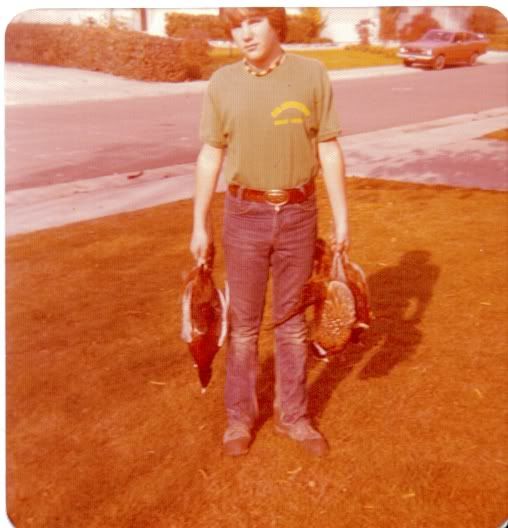
Our own experience with shotguns turned out less eventful than some of my acquaintances.’ Absolutely no funny business with the shotguns and, aside from a whole mess of shattered clay pigeons, we shot only two pheasants in all our outings, and that happened in one day. (See picture of this humble blogger holding the two lucky birdies.) We would have bagged a few more over the season, but accompanying us were the two most undisciplined German Shorthaired Pointers known to the hunting world. We would be walking an alfalfa field early in the morning, skunked as usual. Then a jackrabbit would dart across the field, and the two “trained” dogs would take off after it barking up a storm. Straight ahead, but just out of range of our guns, a bunch of pheasants would flush – pheasants that would have been game if the dogs were knew anything of their breeding.

When we did get the two birds, no one really knew who got them – we all shot at once. When we landed one of them, it was still flopping around…and it was at that moment I lost my taste for hunting. I don’t know why I’m such a sissy when it comes to killing mammals and most critters larger than a pot roast; I can kill spiders, flies, and other pests, but I just have a thing about larger animals. I guess it’s kind of an anthropomorphic thing – it is closer to a human. This, of course, doesn’t stop me from telling ranchers to go ahead and slaughter them steer. I’m waiting for my steak. I guess I haven’t thought this out thoroughly. A guy I work with has a picture of himself and a dead deer he presumably killed – the proud hunter holding the buck by the antlers. I don’t know why I have a problem with that kind of stuff; I don’t mind venison – especially jerky! Anyway, I used to wish that I shot wide that day, but only God knows. This incident didn’t stop me from finishing-out the season; I just wished I didn’t have to shoot again. In fact, I didn’t.

Getting up at 5 AM on a winter morning was tough for me, even though I was a teenager, but at least we were walking these fields. Duck hunting is something completely different. With pheasant, quail, dove, or turkey hunting, you are always moving; with duck hunting, you are standing still in waist-deep freezing water. I tried duck hunting one time. My neighbor Pat invited me when he found out that I hunted pheasant. He told me about how much more enjoyable it was than pheasant or quail hunting, which he also did.

On one very cold winter morning, we parked his truck and walked to a blind he said he used quite often. Pat let me borrow a pair of waiters. They were excessively big, but Pat told me since I wouldn’t be walking around much, it didn’t really matter. What mattered to him was the orange shotgun safety patch I had my mom sew on my hunting vest. I figured I needed to add some flair to the otherwise drab apparel, and the patch I got for completing the class was all I had. Pat said the bright orange in the patch is visible to fowl and may cause ducks to stay out of shooting distance; he also thought the patch was straight-up gay, which in retrospect he was right. I couldn’t help but comment on how cold the water was. Pat reminded me in an annoyed whisper to be quiet, but I couldn’t stop my teeth from chattering. Some time later, I let out a small chuckle when I noticed the floating bubbles in the water were actually thin slices of ice. Pat shot me a mean stare, then looked at my patch again and rolled his eyes.

After not seeing one duck in range for over an hour, Pat left the blind for a while, telling me that he may know of a better location where the ducks may not be flying so high. When he returned with what looked like an instant case of herpes, I asked him what happened to his face. He nonchalantly told me that he had been “rained on,” as if it was something all duck hunters experience from time to time. If the freezing cold weather, immobility, and the fact that ice slices were conspiring to create a skating rink around us wasn’t bad enough, this “rained on” crap was too much. But what was I supposed to do? He had the keys to the truck. Later, I found out that being hit by shot falling from the sky does not hurt or cause shot herpes (my term) – Pat must have caught spray from a discharged shotgun leveled. If he would have been any closer to the center of the spray, he might’ve been seriously injured, and I would have got to ride with him in an ambulance with a heater and warm blankets!

After spending three hours in a giant glass of iced tea, Pat called it quits. On the way home, Pat stopped at A&W for lunch. While the sun was up, my wet jeans were ensuring that even if it hit 80 degrees that day, I still would be miserable until I shed my denim. When Pat ordered a root beer with his lunch, I told him he was crazy. It was at this time that Pat introduced me to the concept of “Reverse Chemistry.” He told me that Eskimos often eat chunks of ice to keep warm. “You see,” he explained, “when the ice hits your system, your body melts the ice and warms the water and, ultimately, your body.” So I ordered a root beer, too. A word to the wise: If you think slamming down an ice-cold A&W Root Beer is going to make your frozen nuts drop again, think again. I sat there in his unheated truck, my teeth chattering through a Teen Burger and a side of calcium deposits, breathing to myself, “Come back, duck blind, all is forgiven!”

Of the few gun tales I have to tell, this last one is the shortest…and darkest. It is also, praise the Lord, the only one of which I do not have firsthand experience. Daniel was an early childhood friend of a friend. Though he lived just around the block, I lost touch with him in my early teens. In his 20s, Daniel became a member of the National Rifle Association. He was also trying to recover from PCP poisoning. I know very little about what happened to him other than he must have smoked pot laced with the pesticide and was later arrested while having a reaction to the drug. After his loving parents had taken him in and tried to help him recover from this very serious problem, he had another reaction that led him to gun down both his parents. His last act as a free man was to call the Sheriff’s Department and inform them of what he had just done.

By the time Daniel murdered his parents, I was completely out of the hunting thing. I remember thinking to myself when the news broke, “Whatever happened to our shotguns?” My guess is, we sold them. With all the gun violence happening in this country over the last 30 years I can see why there are people who want to control the manufacturing, purchasing, and use of firearms. While I have never felt that we should ban weapons used for gaming, I do believe we need to remove handguns and automatic weapons from the market. As for hunting weapons owned by not-so-stable people like Daniel, we need to be far more thorough in our screening and maintenance of gun ownership records. I know this sounds like a red-tape nightmare, but there must be a way to do this effectively. There is something far more important at stake than protecting free enterprise and our “right to bear arms.” I think Daniel’s case is a good argument for that. As for the other loose cannons I’ve been lucky enough to dodge, I haven’t seen a reasonable gun control proposal yet that can keep you safe from the lunacy of puberty.

Thursday, August 02, 2007

My All-Too Mortal Game

pat·zer 'pät-s&r
an inept chess player
Source: Merriam-Webster Online Dictionary


I recall filling out the personal information on the Profile page of this blog when I started this thing. Favorite Movies and Favorite Books, as well as my occupation, were easy fields to fill. Where I got stuck was on the Interests field; I had none. This is not exactly true, but unlike my sister, who enjoys golf, hiking, snowshoeing, kayaking, and a plethora of other healthy activities, I had none — or at least none that I wanted to list. I mean, at the time I was entering the information, all I really liked to do was sit on my ass and watch movies, listen to music, and read — that’s it.

Since that initial entry, I am happy to say I have added an interest that requires some movement besides operating a remote control — working out. The thing is, it’s not really an “interest,” it’s more like a chore — like washing my cars. Another interest I listed that is more of an on-again, off-again/love-hate affair is chess. Chess can also at times seem like a chore. It is during those times — usually during a correspondence chess tournament that can become long and drawn out — that I lose whatever transient passion I had for the game, and the rest of the moves become obligatory.

I first became interested in chess back in 1994, after seeing the film Searching for Bobby Fischer. After the initial excitement of discovering something new, it became like anything else. In that first year or so, I bought a chess set, chess software, and a couple of books on the game, and as if I knew I was going to become a tournament player, I became a member of the US Chess Federation. This kind of behavior is not unlike me — diving into the latest interest with an open wallet and myopic vision.

The next thing I did was visit a Sacramento Chess Club meeting in hopes of making some friends. I found the chess players there very competitive and aloof. After losing games to a couple of people who thought I was some kind of a joke, I decided to ask for help. The first person who agreed to help me was one of the club’s best who mistook my request for personal training as a request to train my protégé son. It turned out he was not interested in teaching someone who was old enough to grow facial hair. I left discouraged. Online gaming was no better. I joined the Internet Chess Club only to find I was the worst player in the world. I was thoroughly humiliated on a couple of occasions by members who mated me in less then ten moves and then said things like, "My mom wants me to get off the computer and go to bed." or "37, you're older than my dad!"

Shortly after this, I discovered that a top-ranked Sacramento Chess Club member was a fellow civil servant and accessible by email through the State email list. I emailed him and asked if he would teach me the basics of chess. This is embarrassing to admit, since most players learn through reading how-to books and playing in club settings; but the books weren’t helping, and I felt I wasn’t good enough to show up at club meetings. The fellow State worker and top-ranking chess club member agreed, and we met at a café in midtown once a week.

On our first meeting, we sat down with our lattes and began a friendly game. A couple of moves later, he asked, “What system are you using?” “What system?” I replied. I never heard of “systems” in chess. (Over the years my "what system" joke has become a tired joke among friends as well as my Blogger account handle. Nobody gets it and for a good reason.) I realized I never learned an opening system for either white or black. Chess was getting more complicated by the game.

About six sessions and two months later, we had our last meeting. I told my own personal chess master that I decided to give up the game. This was in fact a lie; it was getting more embarrassing with each time I paid him to teach me what most people could learn by just playing the game more often then I was playing it. My personal chess master was also getting tired of teaching me. Though he did not say this to me directly, on more than one occasion, when he was frustrated that I could not give him an intelligent reason why I made a particular move, he would say through a sigh, “Look, if you are not going to respect the game, you should stick with checkers.” I know he didn’t say it to hurt my feelings, this guy is a USCF Senior Master and loves the game, I think he was hurt that I was disrespecting that game that he has studied for years.

I also felt tired, and this game requires a lot of concentration and dedication that I no longer wanted to dole out. Take for instance how the number of possible moves in a game grows geometrically with every move. The first move of the game is easy: the player has twenty legal moves, but as the game progresses, the permutations become mind blowing especially when the Queen, Rooks, and Bishops get moving. Perhaps I was taking this all too seriously, but I felt I wanted to learn the science of chess and play in rated tournaments – not just how to play a friendly game. This was my downfall. Ultimately, chess ended up like the drums when I was a kid. When the instructor told me I would not be the next Gene Krupa unless I practiced many hours a week for many years, I dropped the sticks and said forget it.

One of the positive things that came out of these sessions was that I learned the first few moves of three opening systems: for White openings, the Colle System; for Black openings, the Center Counter Defense and the Tarrasch Defense. I purchased books on these three opening games, but as par for the course, never got past the first few pages of each book. In this period of training, I bought many other books on chess — most I don’t think I ever opened! There they sit on my bookshelf, right next to the books on web design, in-line skating, Argentine Tango, and all the other things I thought I would be an expert in by now.

I experienced a renewed interest in the game some time later when I started playing email chess with Gus, an acquaintance from work. The outcomes of the games were not much different from playing either online or at the club -- my opponent would beat me or we would draw. Still, Gus was humble and never belittled me. It may sound childish or immature, but it is amazing how small you can feel by losing to someone at chess. If I lose at basketball, I can say I am not athletic. If I lose at a video game, I can write it off as a child’s game. Even if I lose at dominoes or backgammon, I can laugh at how bad I am with numbers. Since chess is all smarts and there is no luck involved, when you loose it is as if your opponent just placed a dunce cap on your head and then proceeded to laugh in your face – it can be that brutal and humiliating.

Last year, Gus and I played another series of games. The outcomes were the same until I started reading the book Logical Chess: Move by Move: Every Move Explained by Irving Chernev. I beat Gus in the last two games we played. While I’m only talking about two games out of probably a half dozen, I think it rattled him; he never lost to me before, now he lost two in a row. We agreed to play OTB (over-the-board), but it never happened. I should have been inspired by these victories and continued to work my way through Chernev’s book (which requires playing through many games while the author explains his tactics). I should have started mixing it up with the guys at the club, and dispatching those pubescent punks online; but for some reason I stopped working through the book and didn’t get back into the game. Perhaps I was comfortable losing — man, that sounds pathetic!

Though I have not played much chess in the last year, I still eagerly await the paperback release of David Shenk’s acclaimed book, The Immortal Game: a History of Chess or How 32 Carved Pieces on a Board Illuminated Our Understanding of War, Art, Science and the Human Brain. The book attempts to illustrate how chess has been an omnipresent factor in the development of civilization, from its invention in India around 500 A.D. to its importance in the development of artificial intelligence. Shenk tries to explain why chess, above the thousands of games invented and played throughout history, thrived within every culture it has touched. Just about everyone has played the game at some point in their lives, and its rules and pieces have served as a metaphor for society, influencing military strategy, mathematics, literature, and the arts.

After browsing through the hardcover edition of Shenk’s book, I bought Bobby Fischer Teaches Chess — a collection of chess puzzles that I worked on during my commutes. I felt inspired that I could solve some of the puzzles that were taken from real games with the greatest player America ever produced. I stopped when the puzzles became too difficult, and I decided to spend my commute time doing something easier on my brain: napping. Recently, I tried to pull out my chess set. I don’t know why exactly. There was no one to play against; I guess I just wanted to lay out the board and pieces. Even with a cheap set like mine, chess is one of the two most beautiful games to behold (pool being the other one; unfortunately, I don’t have a pool table). I looked for my set for half an hour before I quit, picked up the remote control, and watched The Simpsons. I’m doomed to be a patzer-for-life if I can’t stay focused on the game, but I feel so warm and toasty (read superior) watching Homer make an idiot out of himself. If only he played the Immortal Game!

Wednesday, July 11, 2007

Back on the Wagon
For nearly twenty-five years, I have been fighting a losing (err gaining) battle with my weight. I started putting on weight shortly after getting married, which is not surprising. However, during the pregnancy of our last child, I stopped stepping on the bathroom scale, and the once pristine holes at the end of my belt started to become worn and stressed through use. From 1989 to 2007, I gained somewhere in the ballpark of 50 pounds. A few years ago, when I weighted in at 222 lbs., I joined Weight Watchers for what would be the first of many times and lost ten pounds only to gain it all back and more. In March, when I joined Weight Watchers for the fourth time, I weighed in at a whopping 235 el bees!

The reason for the addition of half of those pounds had to do with a vacation my wife and I took a week prior. While we didn’t take a cruise — which have the dubious rep for giving customers extra souvenirs that only their bathroom scales claim — it’s amazing how much a guy can eat when he has an “All Inclusive” bracelet on his wrist. The food just kept coming as if the bracelet was some sort of prime rib and twice-baked potato magnet, and, of course, I felt obliged to partake of the magical magnet’s bounty. When we returned from the trip and the scale spun past the numbers and rested on “Orca,” I knew I had to start a diet again and this time stick with it. It wasn’t just the tight clothes and the dwindling self-confidence. This time, my wife, an RN, preached to me, “You know, the older you get, the harder it is to lose the weight, and the more critical it is to stay in shape, blah, blah, blah, your ankles can’t take the weight, blah, blah, blah, your going to be 50 in December, blah, blah, blah.” She was right, though.

My first day back at Weight Watchers was very different from the times before. Usually, I paid my dues, weighed in, and then, in the spirit of “makin’ that change,” I went somewhere for lunch and ate like a pig. This time, however, I stayed for the pep talk. There was a new leader—a big queen named Sam. Sam is the epitome of empathy. While I get a little uncomfortable when he speaks to the women, as if exchanging “girl talk,” most of the time he’s a great encouragement.

Weight Watchers tries to encourage closeness and camaraderie among its members, but these meetings can sometimes end up like light-hearted bitch sessions, and being one of the few heterosexual men in a banquet room full of women and one or two gay men, I feel a little out of place — and occasionally the target. “My husband can’t figure out why I get mad when he brings home a box of donuts,” which is followed by a chorus of “Yeah!” and “Tell me about it!” I try to be invisible during these sessions, but Sam will occasionally pick me out to comment. The only thing I can do is stab my poor wife in the back and say, “I don’t drive, so my wife does all the shopping.” The first part is true. The second, a bald-face lie.

These weekly sessions only last about thirty minutes. The rest of the time, I am on my own. I sometimes wish I had a sponsor, like what an Alcoholics Anonymous member has. Or, maybe a zealous analyst like the one Burt Lancaster’s character has in the wonderful
Local Hero — some guy wrapping on the window at 33rd Street Bistro when I go for the fries I shouldn’t have ordered in the first place. Alas, Weight Watchers groups don’t work that way.

Of course, one of the cornerstones in a reasonable weight loss program is exercise. Weight Watchers does not ignore this requirement like all those diet pill and “lose weight while you watch television” programs do. I have been a member of a health club downtown for many years now. I rarely used the place except for the spa facilities and occasional Argentine Tango lessons, but this latest stab at trimming down has moved me to take my membership seriously.

I now attend the club three days a week — two days lifting weights and (only) one using one of those elliptical contraptions for my cardiovascular workout. (I’m supposed to do these four days a week, but that just ain’t gonna happen — at least, not now. Since I have never taken exercise seriously, I was pleasantly surprised that I don’t really mind doing it — at least the weight training part. However, there is a specter that haunts me every Monday, Wednesday, and Thursday when I approach the club: will there be any men that I know from work in the locker room?

The prospect of being naked around men from my work is one of the things that have always bugged me. I probably wouldn’t be hung up about this if the club were not so close to my work. I just don’t like the idea of fellow male workers knowing what I look like under my clothes. A philosophy professor back in my college days once posed the rhetorical question: “Why are we so fascinated with what others look like under their clothes?” I understood his point from a lofty, philosophical vantage, but when the rubber hit the road, I knew exactly why — it had something to do with why I couldn’t stop ogling Lisa, a fellow editor at the college campus newspaper.

I think what bugs me so much about being seen naked by someone I work with is that he will know my secrets. Not that I have a prison tat on the small of my back that reads “Bitch” or some disfiguring mark or burn; it’s just that I don’t want anyone to “know me” beyond what I look like clothed. If I can’t make Calvin Klein look good, I know I will look horrible in my birthday suit. On the other hand, I walk around the locker room, shower, dry, and even piss and crap completely naked among strangers, and that seems okay. I guess I can’t really explain that contradiction.

Working with weights is not new for me. When I was in summer school before my first year in high school, I had a weight training class. I learned a lot about weight training, but most importantly, I learned I didn’t like it. I rarely opted for the weight room when selecting specific activities in P.E. — it only magnified my impotencies. The same is true now, but at 49, at least some of that feeling has subsided.

When I hooked up with one of my club’s personal trainers, she set me up with five different weight machine stations as well as some “core” exercises employing a mat and a “fitness ball.” The core exercises are the most grueling, but at least I felt like I could do them without revealing just how pathetic I am. The weight machine stations are a different matter.

It’s humbling to follow some of the women during routines to find they lift considerably more than I do. Then there are the times I am popping a hemorrhoid at some station, and after (barely) finishing one rep, a woman will come up to me and ask if she can “work-in” her reps with mine. This is especially humiliating when, after she is done with her rep, I have to readjust the weights down, since she lifts 40 pounds more than I do.

When I am not feeling like the club weakling in front of these hard-bodied women, I am dwelling on how some other women mistake this part of the club as a social room, of sorts. One lady in her 40s has a personal trailer that accompanies her to every station of her workout, every day. She picked a young, handsome buck as a trainer, but he doesn’t do anything but listen to her gab. I think she would be an attractive older lady if she didn’t try to look twenty-five. It’s this trainer’s job to look good and say “uh-huh” and “I know what you mean.” I could have chosen a personal trainer that attended all my workouts, but that costs extra. I have no idea how much this lady is paying for the eye candy, but I know it’s not cheap.

Thanks mostly to the three days I workout and less to eating responsibly, I have lost some weight. And even though I am cutting back on my eating, I love food far too much to go on a real, Weight Watchers-approved diet. I have lost about ten pounds, but I am finding the weight beyond that tough to shed.

Back at the Weight Watchers meeting, Sam announces with his booming queen voice, that I have lost ten pounds. The crowd applauses enthusiastically as Sam hands me a gold star sticker — failing to remember that he has celebrated my first 10-pound loss two other times in the last five weeks; I keep gaining and losing two pounds. I know the next step is the toughest one: easy on the starches and fried food, and drop the French-fries. If you ever see me in a burger joint, I’ll be the guy crying in his dinner salad with light vinaigrette dressing!

Sunday, May 20, 2007

Jason Bourne and the Decline of American Cinema

Between 1979 and 1989, I was a film critic for two college papers, three small-market publications and – for six or so editions – a contributor to the “Mick Martin & Marsha Porter Video Movie Guide.” (Some time in the late ‘90s, before the publication’s name changed to the uninspiring “DVD & Video Guide,” the editors removed my reviews and credit from the publication -- so don’t bother trying to find my words of wisdom anywhere but on this blog, unless you dig reading from a microfiche projector.)

Does this make my opinion on cinema and film trends any better than yours? Of course not. Still, I would like to think that my countless hours of viewing, reviewing, and researching films over a quarter of a century counts for something. (I also spent five of those twenty-five years working in an independent “art house.”) So, when I see a couple of trends developing over the last twenty years that frustrates me, I feel like I must speak out. (Anyway, this is my blog so I’ll write what I want!) Since no one wants to hear me talk about how TCM is the best movie house in the world, I guess I will use this space to lay out a couple of things I think are disturbing with Hollywood. Mind you, there are more than just two disturbing trends in film today and, of course, my biggest problem is not with today’s films, but with today’s TV-fed audiences. Still, I think I am in the majority when it comes to this problem, so I will not spend any time on how much I hate those who mix socializing with movie viewing or those who just cannot turn off their mobile devices while inside the theatres.

Sex
A couple of months ago I saw the film, 300. Based on the historic Battle of Thermopylae in 480 BC, 300 had a lot of violence and gore, not to mention a steamy sex scene. I would have thought that anyone – whether a historian, an action-movie maven, or just someone who came in off the street for a box of popcorn and something to watch will chowing it down – could not help seeing the sex scene as some sort of apparition, or even a director’s joke – it has absolutely no place in the film.

When I saw the infamous scene, it stuck out as if the projectionist had mistakenly switched a 300 reel with a soft porn reel – I almost turned around and looked at the projectionist’s booth the way I would if a hair was in the gate or if the film broke. Of course, neither of these were the case – there was Lena Headey as Spartan Queen Gorgo sweating and moaning like an adult film star, grinding away on our valiant King. What was far more aggravating is how the scene was met with such indifference, as if filmgoers expected to see some T&A for their $9.50.

It is frustrating to hear fellow film enthusiasts argue that there was nothing wrong with that scene in this film, as well as in other films that sport gratuitous sex. My like-minded friend, Gus, complained to me how his friend, Brad, had acted as if Gus was crazy when he protested the scene’s inclusion in the film. About eight years ago, I had the very same argument with Brad about the sex scene in He Got Game. Brad had told me it was the best film Spike Lee had done (up to that time). I agreed, except for the scene where all the college girls have sex with the prep. I suggested to Brad that the graphic sex could have been left out and, by implication, the point of the scene would be maintained. Brad’s reaction was as if I was proposing to rip the heart out of the movie.

Of course, I would not spend all this time on poor ole Brad if I thought he was the only person who judges movies with his libido – it is an epidemic. I have had countless arguments with many people about the cynicism of Hollywood and how it, above all industries, knows the power of sex and exploits it at the cost of content. Brad just looked at me dumbfounded others go to great, and ultimately embarrassing, lengths to try to justify sex on the screen. Here a fellow Netflix member goes to great lengths to explain the art behind Viggo Mortensen and Maria Bello getting down multiple times in A History of Violence:

"These scenes honestly, effectively reflected the emotions permeating the characters at the time. The first, a playful (dress up) game that turns into an intense expression of their raw love. These scenes honestly, effectively reflected the emotions permeating the characters at the time."

I wonder if the filmmakers would have the two characters express such “intense expression of their raw love” if instead of Viggo and Maria the two main characters were portrayed by John C. Reilly and Whoopi Goldberg; I wonder if my fellow Netflix member and others would still defend the sex scenes.

Since I am a Christian some of my non-believing friends write off my opinions as puritanical dogma, but they fail to take note that I am watching these movies in the first place. Many Christians no longer watch movies with ratings beyond PG and do not watch cable television. At times I think I, too, should give up and join my fellow Believers who avoid cinema and television the way they avoid drugs, alcohol, gambling, and popular music. However, I love the art form even if so many of these “artists” have traded content for an appeal to the common denominator.

Sex is a powerful tool in cinema and, if used through implication, helps plot development. As an example, the “sex scene” in The Bourne Identity transforms the two characters, Jason (Matt Damon) and Marie (Franka Potentee), from strangers working together for their own self-preservation into lovers, and everything that happens after that scene changes the entire meaning of the action that follows. What is fascinating about this “sex scene,” vis-à-vis the current trend of sex in American film, is that virtually nothing happens: two people kiss, they begin to disrobe, and the scene cuts to the morning after – we don’t see Potentee’s breasts or ass or the two making love, we don’t even see them supposedly naked under the covers in the morning. Did we have to see the sex? The director proves to adult viewers that there is no reason for it, and I never heard Brad or anyone else complain about it. The day that films get lower ratings or are not recommended by friends and family because none of the characters have sexual intercourse, will be the day I officially hang up my popcorn cup!

Shorter Takes, Whip Pans, and camera behavior for ADHD viewers
The sequel to The Bourne Identity illustrates another disturbing trend in Hollywood. Unlike Identity, The Bourne Supremacy employs whip pans to emphasize action (as if all the car chases didn’t sufficiently scream, “This is an action film!”). I developed a headache watching it in the theatre. When it came to cable television a year or so later, I watched it, remembering what a cool story it is, but forgetting all those annoying whip pans and spastic hand-held camera moves ala NYPD Blue. While it is true that I am picking on this film only because it is a convenient segue into this other bothersome trend, my headaches don’t lie. The worst thing about this technique is that it is a cheap way to emphasize action – I used to do this stupid effect on the family Super-8 camera to punctuate action; I had an excuse, I was a teenager who fancied himself the family biographer. What is director Paul Greengrass’ excuse? Unfortunately, Greengrass has directed the soon-to-be-released third part in the Robert Ludlum trilogy, The Bourne Ultimatum. I will definitely see the flick, but I’ll medicate myself first, just in case.

Shorter takes is another depressing trend that seems more like an inevitability than a fad or a trend (i.e., whip pan and other hand-held camera techniques). Thus, this is more depressing than some sophomoric director’s contrivance and it seems indicative of the times. This becomes obvious when comparing a recent film with just about any film from the 1970s and earlier.

I did not realize just how much I was conditioned to “need” shorter takes in a film until I saw Michelangelo Antonioni’s 1975 film, The Passenger. . It took a while to get used to the pacing and the long takes, but ultimately I grew to appreciate what seemed to be a more “natural” presentation than the frenzied camera work that is seen in so many films today. In researching the short/long take issue, I found an entry in the indispensable Wikipedia.org on the Long Take. The entry provides many movie and television productions with notably long takes. Admittedly, there are still filmmakers out there who employ longer takes – in Manhattan Woody Allen employs a static camera and has his subjects move across the POV adding a edgy feeling to the scene. Today, we would most likely see the hand-held camera panning back and forth. Sometimes I think these films should be viewed with a dose of Dramamine. The long take is not dead yet, but it is becoming more of a gimmick or a badge of honor, rather than a standard throughout the industry.

Okay, you can stop reading. I’m finished ragging about how rotten things have become in American cinema. Anyway, North by Northwest is up next on TCM and I just have to see the movie’s sex scene. You know, when Carey Grant and Eva Marie Saint kiss just as their train goes into a tunnel…sexy stuff!

Sunday, April 22, 2007

In God I Trust (even if others are having second thoughts)
I was in my weekly Bible survey group talking about some recent news when one of the members of the group showed me the new one-dollar coin. I never had seen it before, nor had I even heard about the controversy surrounding it. The U.S. Mint has relegated some of the markings common to U.S. coinage to the rim: the year of the coin, the “E PLURIBUS UNUM” motto, and the “IN GOD WE TRUST” motto. Normally, our group does not spend time talking about politics, and that always has been a blessing to me since I have always felt like I was the only liberal in the room of older men who receive their political instruction from Rush Limbaugh.
The news of this coin design, however, fired up the group and sidelined the Scriptures for longer than most worldly issues have in the past. “They are trying to minimize God,” one man cried. “The edges of coins naturally wear down, so they are hoping that the word ‘God’ will wear down, as well.” “They are ashamed of God.” Most of the comments bordered on the hysterical, and whenever the innocuous “they” word is thrown around, any kind of intelligent discourse seems to be sucked out of the room. As usual, I held my tongue, quietly writing down on one of my Scripture-memory index cards a reminder to investigate this later. These few words are my thoughts on this matter.
While I have always felt sorry for Michael Newdow for being so hell-bent (eh-hum) on wanting the word “God” removed from the Pledge of Allegiance, I still think he has a point. I personally feel that removing the word “God” from things like currency, pledges, and oaths is not such a terrible thing. Conversely, I feel that this movement is a sign of the times – and that is a bad thing. If popular sentiment is calling for a change in our government, then I am usually for it, especially if it is fighting against one of those “tyranny of the majority” kinds of things. However, I am against a government that is so religious that it legislates religious canons (like many Islamic nations); but like my Christian brothers, I realize that fewer people believe in the Judeo-Christian God and more specifically Jesus Christ, and that is truly depressing.
Removing the word “God” from things like currency, pledges, and oaths only would set things back to the way that they were about fifty years ago – ironically, back to the time that so many of my Bible survey brothers pine over – “the good ole days.” For instance, many do not know that the government added the word “God” to the Pledge of Allegiance during the Cold War; the pledge had existed for 60 years without the word “God” in it. The motto “In God We Trust” has a similar history; however, listening to people like my brothers in the Bible survey, you would think the Anti-Christ had moved into their neighborhood.
You may have noticed that I carefully have written “God” throughout this tiny post, making sure that I preface each one with “the word” when applicable. You see, I believe that God is in everything, whether or not man decides to give Him the credit.
God will survive any government, even the current one where a supposedly “godly” president tells so many lies and places greed in front of brotherly love. Still, I have no illusions about Barack Obama and Hilary Clinton, just as I had none about Bill Clinton – as my old hero I.F. Stone said so often, “all governments lie,” and that includes idealistic politicians who run them.
So exorcize the word “God” from all of these worldly things and still, money – that is often the root of evil – will continue to be the medium of exchange; pledges – which often are broken – will still be chanted; and oaths – that are lied upon – will still be taken, if not so help God, then so help your secular-humanist Huggy Bear. It all ends up business as usual or, as King Solomon said in Ecclesiastes 1:9, “There is nothing new under the sun.”

Monday, April 16, 2007

The Posole Dash
I used to run a small warehouse in downtown Sacramento. Actually, it was less of a warehouse than a 5,000 square foot, hollowed-out office space with pallet racking and a forklift modified not to go through the eight-and-a-half-foot ceiling.

We were a bunch of guys who cussed and joked too much and encouraged each other’s poor eating and communication habits. Occasionally I would hire a female, but they would never last long; the testosterone-laden environment was more conducive to farts, belches, and jokes about these two gastric expulsions than things more feminine. Another thing that sped up the elimination of temporary female personnel was the warehouse’s refrigerator. Even now, when women make up nearly half of the staff and the atmosphere is more professional, we don’t always get around to cleaning the fridge properly, and the females are the most vocal about this problem. Still, compared to the old fridge, the one we have now is as sanitary as a surgical instrument table.

It was not that we never cleaned the fridge back in the old warehouse days, but we would invariably wait until things got vile before one of us got around to cleaning it. When that happened, there was usually only an old green sandwich or a half-bottle of orange juice that was no longer orange. However, there was one time none of us will ever forget. The people who lived through it would rather forget it, but I tell this cautionary tale to the rookies who skip their turn cleaning the break area.

In our fridge, we had a huge bowl of posole. Occasionally, women would feed us guys something they made from home. This was usually due to some maternal thing, but in this case, Rita, a woman who worked across the hall, had potluck leftovers and didn’t want to lug the stew home. When she first brought it in and asked if we wanted it, I saw a thick stew that would have smelled appealing any other day, but I wasn’t interested having just eaten. All the other guys had already eaten, too. I knew I was going to try it the next day and one of my staff also vowed to have some soon.

For reasons I have long forgotten, I never did try the posole and I think that also goes for the rest of the staff. So the posole sat in the fridge. Days turned to weeks, weeks to months, and the posole remained in the fridge. Since I was (and still am) foolish enough to eat out for lunch or, when I am a little more fiscally responsible, bring in a sandwich and chips, I never looked in the fridge, nor did I ever hear a peep out of my staff about the posole. For all I knew, the stew had been removed from the fridge months ago.

I didn’t know Rita was in the shop until I heard her cry “Oh my God!” followed by what sounded like a dry heave. As she left, she pointed with a quivering finger and said, “I need my bowl, but I’m not washing that out of it!” It took me a few seconds to process this statement. The required set of synapses had to fire for me to conclude that the bowl of the posole was still in the fridge. I chuckled almost in disbelief; I mean really, who would leave a bowl of stew uncovered in that dirty icebox for that long?

When I approached the fridge I could smell it; the remaining stench from when Rita had opened the door hung in the air like a death haze. I have never smelled anything like it. This was worse than the day my friend JT and I visited the old County Morgue. JT was helping me look for possible jobs and there was an opening as an office clerk there. After receiving the details of what this clerk’s responsibilities were–heavily peppered with macabre humor–we were on our way out of the building when JT cut in front of me and stepped on a pressurized doormat that opened a door to the corpse hold. The cold air hit me in the face, then the smell, and then, after my eyes focused, I was staring into a room of cloaked dead bodies on gurneys–one whose arm had fallen off the gurney, purple, grey, and black. JT impishly smiled at me. The whole experience was permanently burned into my memory cells. Thanks, JT!

I don’t remember getting the chance to look at the bowl or even shutting the door, but someone must have. I spoke with the crew about the situation as if I was choreographing a multi-pallet shipment. The task force consisted of three people: Brad, Ricardo, and me. I lead a five-man staff, but one of them was hired post-posole and the other guy, a problem employee from the beginning, made it perfectly clear that he didn’t like posole in the first place and told the woman so when she dropped off the bowl three or four or five months ago. We split up the tasks.

We had to move the bowl of posole approximately eighty feet to the nearest toilet where one of us would do the honors. Ricardo valiantly volunteered to take the bowl all the way to the bathroom, but felt his vomit launch begin to countdown when he reached in the fridge to pick up the bowl. He was out. It came down to Brad and me. I was proud of Brad for being a team player, even though the Irish wimp cannot handle anything remotely spicy and didn’t want the posole in the first place. (Brad couldn’t even muster a second bite out of a mis-delivered McDonald’s Spicy Chicken Sandwich. McDonalds, I tell you!) Brad took the first seventy or so feet, setting the bowl on the lobby’s candy machine! Sweat collected on his freckled brow; he was done.

Now it was my turn. Like a fool, I picked up the bowl before checking to see if someone was occupying the first stall. I had to double back – not only was the first stall occupied, none other than Tim Rothschild occupied it. Rothschild prefers to do his business in the basement so fewer of his co-workers have to partake in the byproduct of all those Snickers and Pringles he stashes in his cubicle.

I couldn’t wait in the lobby with the posole and there is no way in hell I was going to take it back – I left the stinking bowl on the candy machine. No one would be buying any Snickers this afternoon. I went back into my office and drank some water, and released some frustration towards sissy Ricardo: “My God, man, you’re a Mexican, proud of your tolerance for habanera peppers, and you can’t handle a little necrotic pork?” Speaking of necrotic, I checked the bathroom again about five minutes later, and Rothschild was still there.

I waited a good ten more minutes before bothering to check again. By this time, the entire lobby reeked. I peeked in the Men’s room to see that no one was in the stall, but Rothschild’s essence was as strong as if freshly squeezed. I couldn’t wait any longer. I grabbed the bowl, ran into the bathroom, into the first stall, only to notice as I bent down to dump the posole that someone was in the back, handicapped stall.

As I bent over and began pouring the rotten stew–dry heaving all along–a bone, hidden in the mucus, slid out and hit the porcelain with a resounding “DINK.” I couldn’t laugh, but still had to wonder what the person in the other stall was thinking. Let’s see: a guy runs in to a stall, stands before the toilet and evacuates a gallon of the foulest smelling fluid from his stomach, and then accidentally drops something into the swill. Whatever it was, it was worth diving into his own rejected lunch to fetch it. Is a Rolex worth that much?

I threw the shiny, slippery bone into the paper towel receptacle, washed, and dried the bowl, all the while still heaving and brought the bowl back to the warehouse. I never knew who was in that other stall, and I don’t know who gave the bowl back to Rita. That night we defrosted the old icebox – keeping the door open to the max, hoping the smell would dissipate by morning.

Now, whenever my name comes up on KP duty, I preface my fridge cleaning with an email to all staff members reminding them how merciless I am about throwing out anything that is not clearly marked and that doesn’t look right. Some poor bastard once lost a half-full jug of Odwalla juice – how was I to know it was still good, it was green! I tell my fellow staff members it’s all for the greater good, nobody wants to do the Posole Dash!

Friday, March 16, 2007

Popular Mechanics and Taquitos

Let’s get something straight before I tell you this tale of impotency and frustration, lubed with plenty of dirt and grease. It may not make this blogger any less pathetic, but at least you will understand this story – and me – a little better.

My father is a master mechanic and I am not. There, I said it. He started down his personal road by tearing apart old engines to see how they worked. He found that kind of thing fastinating. That never interested me; at the time my old man was wrist deep in motor oil, I was bathing my brain cells in cathode rays, wondering why the castaways on “Gilligan’s Island” never got around to dispatching the show’s namesake, and hoping that Andy Griffith would some day be the President.

In some ways, though, I ended up more like a Gilligan than an Andy. When I became a car owner, my motto was simple: just show me how to operate it and whenever it breaks, I’ll throw money at the problem. This motto has caused me to dole out a lot of money that I would otherwise have saved if I had learned something about car engines beyond adding motor oil and replenishing windshield wiper fluid. However, for the most part, I have no regrets. Further, I have never bought into the stereotyping of men and their cars. Unlike the hordes of car enthusiasts in the country, I eagerly await the fully electric- and hydrogen-powered cars and the abolition of the internal combustion engine. With that said, read on.

A couple of months ago, when my car would not start, I called my auto club to give it a jumpstart. As the tow truck driver jumped my car, I pretended to listen as he told me who manufactured the various parts of my car, in what part of the world this car was assembled, and how he believed the only thing wrong with my car at this time is my battery. I couldn’t tell you anything about my car’s origin except that it has a Japanese name, but I did catch the last part of his rambling. He told me I could now drive the vehicle, but the battery would not hold a charge very long. I had a sudden attack of frugalness and decided to buy and install a new battery by myself.

The tow truck driver’s parting instructions were to drive to the auto parts store and have the staff check the battery and the alternator. Assuming he was correct and the problem was a dead battery, the shop would sell me a battery and even loan me the tools to do the swap right in their parking lot. How hard could that be? The parts store tested the battery and found it was, indeed, the problem. I purchased a mid-range priced battery and borrowed a monkey wrench from the guy behind the parts counter.

While I was removing the terminals from the old battery, a Honda Civic pulled into the parking spot next to me and an attractive blonde woman in a navy pinstriped suit got out of the car. She said “Hi” to me just as I attempted to yank the dead battery out of my car. To my embarrassment, it didn’t budge. I regarded the battery in a real masculine kind of way, but I was really trying to figure out what was holding the battery down – did the plastic of the battery casing melt onto the platform the battery was sitting on? I yanked again – this time in a rocking fashion -- figuring I might peel it off the platform.

A minute of these rocking yanks continued until the woman in the pinstripes came out with an auto parts store employee and the battery-checker cart thing they used on my car earlier. The woman interrupted my rocking telling me I needed a ratchet and a socket to loosen the battery frame. (That's what it’s called. Thanks, eHow.com!) She gave me a pathetic smile as if I was a pound trash puppy. “Right,” I said back too fast. The auto parts guy, through a chuckle, told me I could borrow the tools inside. I felt like kicking his cart over.

I came back out with a ratchet and a socket set and started feeling around for this nut I was supposed to loosen. Got it! However, I found out I could not loosen the nut because the ratchet handle was too long for the cramped area down between the battery and whatever was next to it. I kept trying though, making all sorts of clanking noises and dropping the ratchet a couple of times. It was the second time I was on my knees feeling around for the ratchet under my car when I heard another ratchet working like crazy. I stood up, still without my ratchet-from-hell, to see Miss Pinstripes ratcheting away. By the time I found mine, got up, and brushed off my knees, she handed me an extension saying, “I think you are going to need this.” The sympathetic look on her face had vanished and was replaced with one that would usually accompany a comment like, “I can’t wait to tell the girls this one,” holding back a laugh. I thanked her for it and proceeded to loosen the battery frame.

Another thing I learned that day, along with the fact that car batteries don’t just float around an engine, tethered by two terminals, is that the bracket is not one solid piece. There are actually three pieces to the assembly, not including the nuts. I also learned that when the piece you never really looked at in the first place loosens and falls off the assembly and drops deep into the bowels of the engine, you not only have a hard time reaching the thingy, but you don’t even know what you are looking for.

As I reached deep into my car’s engine guts, trying to find the mystery part, my face pressed against something very greasy, Miss Pinstripes, in a very small voice, asked for the extension back. By this time, whatever bit of pride left in me was as lost as the thing I was looking for. With my face still pressed against the engine part and my right hand sodomizing the motor, I picked up the ratchet that was resting near the radiator and pointed the ratchet, extension, and socket at her like a pistol. She pulled the extension off the ratchet and the socket off the extension, then proceeded to attach the socket back on to the ratchet. This exchange was done without me letting go of the ratchet handle. In any other setting I would have found this exchange to be almost erotic, but with half of my face in dirty grease and her failed attempt to suppress a giggle, it was anything, but arousing. Miss Pinstripes got in her car and drove off.

At this point, I walked into the auto parts store – my right arm and shoulder coated in dirty grease – and asked the three guys standing around the parts counter if one of them would help me locate the missing part. They all smiled and, as one of the guys walked out with me to the parking lot, I heard the other two whispering something about “Two-Face,” followed by hardy belly laughs.

While the employee and I were fishing around my engine, I told him that I thought Miss Pinstripes made off with their socket extension. Be advised, dear reader, at this point I really didn’t give a damn about the store’s property – I was still embarrassed that a woman, professionally dressed, did a battery swap without a hitch and I was still here. The employee told me she had brought her own extension and then finished by saying, “…some people come prepared for this kind of job.” That hurt, but not as much as asking for the store’s extension to finish the job.

When I finally did finish the job and drove off with a new battery installed in my car, I navigated directly to the closest Jimboy’s, greasy face and all. As I inhaled two el Gordos, an order of taquitos, and a large Diet Coke, I took comfort in knowing that eating is one thing I know how to do well.

Tuesday, January 09, 2007

Practical Applications to Memorizing Scripture
In a (baby) step to try to get my writing published beyond this blog, I have submitted the following tiny essay to Cathedral Press for consideration to print on the back of one of their church bulletins that are read by subscribing member churches every Sunday. I know it is a subject almost none of the few and occasional readers of this humble blog have an interest in, but I feel compelled to publish it here, feeling it will probably be the only vehicle for these words.
Many years after accepting Jesus Christ as my personal Savior, I came to the realization that while I was a Christian, I really did not know the Bible. It was not until my pastor inspired me to take up Scripture memory that I began to read more Scripture outside of Sunday church service and Bible Study.

Every weekday morning at my favorite café, I take out the index cards with the verses I am currently working on and drill myself. I begin by testing how many I know. I test if I know the verse by the Biblical reference and, then, if I know the book, chapter, verse, and what the verse says. The idea is to know the verse inside and out. I bring my Bible and study each verse in its proper context. I did not do this at first and it led me to memorizing verses with as much passion as one might memorize a phone number or a street address.

While I did not plan it, the Scripture memory cards turned out to be an effective witnessing tool. If it is not someone asking why I always carry around cards in my shirt pocket, it’s a fellow coffee connoisseur slowing down to read what is on these dog-eared cards that I have on the table every morning. On the occasions when someone comments on these beat-up cards, I show them a verse and hope they stick around long enough to hear my witness. Occasionally I will use the back of a card to scribble down a name or a note to myself when I am at work or at lunch. Once again, people ask me what are those cards on which I am writing.

Since I began trying to memorize Scripture, I have introduced my cards to people at work, on the bus, and in cafés and restaurants; also, I have read more of the Bible than in the past, and have become more confident in my witness because of it.

Wednesday, December 20, 2006

Photobucket - Video and Image Hosting
Why I Don’t Build Boats for a Living

While it does not happen every day, occasionally when strangers learn my last name, they feel the need to comment on it. When I was a kid, older folks would hear or read my name and ask if I am related to the famous classic movie start. Alas, I am not. In my high school and college years, people would tease me about having the same name of a contemporary star of the silver screen. I dreaded some of the cracks my schoolmates made equating me with this star and not the classic actor.

Throughout the years, though, a certain group of people – almost like an elite underground, or purveyors of a profound open secret – would look at me and say, “You’re not related to the boat builder, are you?” This filled me with a strange mixture of pride and shame. The pride came from the confirmation that I was indeed the son of the great boat builder. The shame came from that fact that while I could see these people were impressed – they were talking to an apple that had fallen very far from the tree. In fact, the branch kind of coiled back, and in slingshot fashion, jettisoned this apple out of the orchard. Of course, I should feel nothing but satisfaction that I am my father’s son, and I should not be ashamed that no one is ever going to look at my son’s driver’s license and say, “are you the son of the great California State paper pusher?” I also feel a bit regretful that I did not pursue my father’s craft, though I know it would have been a tough tutelage.

As I was growing up, there were some who thought I had it made; I was going to be a boat builder like my father, run the family business, and carry on the proud tradition. I recall one day camping at Lake Almanor with my family and friends – something we did a lot back then. This one kid, the son of a prominent Sacramento business owner, was skipping rocks across the lake with my brother and me when he turned to us with a big grin and said, “Isn’t it great that one day we will take over our dads’ businesses!” A pregnant silence followed, the kid’s face twisted into a question, and then he queried, “Don’t you guys want to take over your dad’s business?” We did not say no, but our displeasure at the idea of working that close with our father for the next forty or fifty years seemed to be written on our faces.

It is hard to explain to an outsider why I did not become the next great boat builder or even a water sports enthusiast. The best explanation I can offer is the man’s temper. My father was not a violent man; he never laid a hand on us, but it was his anger that totally intimidated my brother and me. I do not know how the Hershey kids (if there were any) handled living with a father who made chocolate all day, but I can just see old man Hershey yelling at his kids how they are mixing the cocoa with the sugar and milk wrong. I can envision the kids just getting sick of their old man yelling at them so often. It is a poor analogy, I know. In my case, my father was the owner and responsible for at least 70% of the work that went into manufacturing each boat and trailer, so we were too close to the whole business. Just as I can see the kids down the street green with envy over the Hershey kids’ prospect, I can also see the Hershey juniors dreading the days they worked in the factory, with the smell of cocoa, milk, sugar, caramel, peanuts, and almonds overwhelming their senses. I can envision them knee-deep in Hershey bars, Reeses, Paydays, Kisses, Kit-Kats, Almond Joys, and Mounds, all the while dreaming of broccoli and Brussels sprouts.

My brother and I were oddities among the children in our neighborhood. When my father got into racing dirt bikes, he would come home from work, hop on his Greaves or Husqvarna, and ride wheelies up and down the street. My friends looked on in wonder, lining the streets like the last leg of a motocross race. To them, my father was the coolest dad in the world; he made boats and could ride wheelies all the way down the street. He did this while his two sons were nowhere in sight.

Things became straight up perverted when my father brought home a brand new Honda 50 mini bike for my brother and me, and we were cowering behind my mother. At 48 years old, I can see how ridiculous this might have looked, but at the time, the kids flocking around the Honda 50 did not know how utterly intimidating my father was. His temper took the fun out of this kind of stuff.

Boating was no different. Family outings on the water were fraught with intensity. “Will I have to drive the boat off or on to the trailer?” which translated into, “Will I get stuck being the one he yells at?” There was also “Will I get up on one ski on the first or second try?” which really meant, “Please God, let me get up on the first or the second try. I don’t want to get that look.”

I blame my sissy self for not being able to enjoy boating like the kids of the parents who bought my father’s boats. Still, the anxiety was real, so by the time I got a car and a job, I did not miss the outings. The woman who became my wife ultimately learned of the legend. Her jaw dropped to find that not only did I not possess a boat, but also that I did not want one. The shockers continued: I was not a trick or slalom skier, and the kicker was that I had absolutely no desire to buy a boat of any kind. My sister bought one of my father’s boats before he stopped building them. Now a quarter of a century later, I have bought her boat – hell has frozen over.

The main reason for the purchase is that my wife has always wanted one, but also my sister needed the cash and my wife thought it would be a good idea to keep a boat in the family, though nobody seems too terribly fired up about boating. Another reason – one that until now has been a secret to all, including my wife – is that I wanted to try to capture something that I missed out on all these years. I really thought I would never buy one of my father’s boats – or any other kind of watercraft for that matter.

So here I am a boat owner in the dead of winter. I have not even seen the boat since I purchased it. I doubt I will even make the trip across town where it sits in storage until the spring when I take it out for a spin with my family. The pathetic thing is all I can think about is which one of us is going to drive the boat up on the trailer when we have finished – not me, I will be the one on the ramp yelling!